
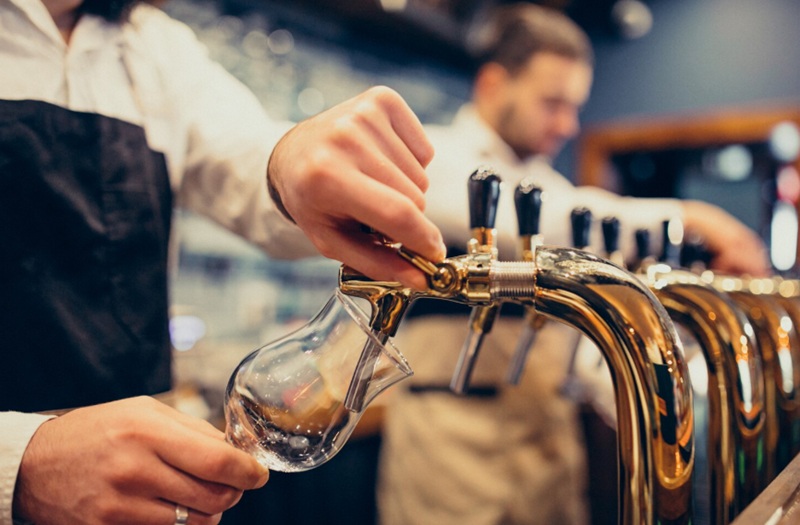
A Saturday afternoon stroll through Bermondsey will immediately reveal something. The railway arches, which used to house storage and light industrial buildings that no one gave much thought to, are now a thriving business, selling £6 pints to people who have traveled from all over London and occasionally much farther, especially to enjoy beer that was produced thirty feet away from where they are standing. It does not appear to be a revolution. It appears to be a room with exposed brickwork and a slight chill. One of the biggest changes to British drinking culture in a generation is taking place beneath the lines at London Bridge.
What the atmosphere suggests is supported by the numbers. In 2020, about 30% of independent UK breweries had a taproom on their premises; today, about 46% of them have. That expansion didn’t occur by accident. It took place in the midst of a long term, agonizing downturn in the traditional pub industry, with over 16,150 closures since 2000 and only over 44,650 remaining. According to estimates from the British Beer and Pub Association, about 161 bars close each quarter. That is more than a statistic. A neighborhood is witnessing the closure of a building that served as a gathering place for three generations on Friday nights, and a hamlet is losing its only social hub.
| Category | Detail |
|---|---|
| Topic | Taprooms vs Traditional Pubs in the UK |
| Industry | British Brewing & Hospitality |
| Active UK Breweries (2025) | ~1,700+ |
| Taprooms Operating at Breweries | ~46% of independent breweries |
| Average Taproom Revenue Share | 27% of total brewery income |
| UK Pubs Remaining (2025) | ~44,650 |
| Pubs Lost Since 2000 | Over 16,150 |
| Current Closure Rate | ~350 per year (~161 per quarter) |
| Average Cost of a Pub Drink | ~£5.20 |
| Notable Taproom Cluster | Bermondsey Beer Mile, Southwark, London |
| Micropub Movement Founded | 2005, Herne, Kent |
The two phenomena are related, but not in the straightforward way that implies pubs are being destroyed by taprooms. The relationship is more intriguing and complicated than that. Taprooms have filled a void left by the conventional model, especially for younger consumers who want to know what they’re drinking, where it came from, and preferably meet the person who made it. Direct consumer sales, whether in the taproom, through an on site store, or online, currently account for about 27% of an independent brewery’s overall revenue. That number is far larger for many smaller operations. Every step of the previous model from brewery to distributor to pub involves the absorption of margins. The taproom avoids the majority of that, which makes a big difference in terms of business.
The stats are rather harsh, so it’s worth taking a moment to consider what a typical bar is truly facing financially. Weighing significantly are business tariffs, which are infamously harsh for hotels. An estimated £1.9 billion more was spent on employees in the hospitality industry as a result of the April 2025 increase in the national minimum wage, and an additional £1 billion was contributed by modifications to employer national insurance contributions. The average pint at a traditional pub now costs around £5.20, which has caused 46% of consumers to reduce their frequency of visits. Anyone who has witnessed a local close can explain this vicious cycle without a trade association report.
In light of this, it is difficult to dispute the taproom model’s structural advantages. Breweries are able to obtain retail margins by selling directly to consumers. The beer is served as soon as possible, usually a few days after it is taken out of the tank. Compared to what is usually feasible in a bar that has thirty items from ten different suppliers, customers can view the fermenters, ask questions, and leave with a much clearer feeling of what they just drank. Choosing this pint over the one two blocks away seems to be a vote for something particular, local, and prepared by folks who are concerned about whether you enjoyed it.
This experiential component is working hard. Many taprooms now offer programming schedules that would have appeared ambitious for a small arts venue five years ago, such as quiz nights, rotating street food vendors, tap takeovers, and brewery tours. There is a cumulative effect. A bar where the beer list hasn’t changed in a long time is not the same as a venue that makes you want to return every two weeks.
This may be one of the reasons why younger customers, who are typically thought to be the group most likely to completely give up beer, are visiting craft taprooms in numbers that have taken the industry by surprise. According to studies provided by SIBA, over 25% of those aged 18 to 24 now routinely order cask ale in pubs, a 50% increase year over year. It’s challenging to determine whether it represents the taproom’s impact on young people’s perceptions of beer, but it’s hard to assume it’s totally accidental.
It would be incorrect to dismiss the conventional pub genre as merely failing because it has its own enduring advantages. Deep familiarity, a space where everyone at least recognizes one another, and a physical ambiance that has absorbed decades of social history into its walls are all things that a well run local offers that no brewpub can readily match.
In many places, the pub’s role as a democratic institution that is truly accessible to everyone not just those who understand the difference between a hazy IPA and a West Coast remains true and indispensable. The exposed tank, industrial style attraction of the taproom is indeed thrilling, but it’s also, it must be admitted, a very particular type of thrilling. On a Tuesday night, not everyone wants to learn about different types of hops.
This picture is considerably complicated by the connected house system. By definition, taprooms provide locally brewed, independently produced beers that traditional pubs are unable to supply due to exclusive purchasing deals with large breweries. Tied pubs are at a significant disadvantage when customer preferences are shifting more and more toward provenance and independence due to this structural limitation, which is not a failure of ambition but rather an economic responsibility.
Although free houses are more adaptable, they still have to deal with the challenges of maintaining numerous supplier connections and the fact that many smaller craft breweries generate volumes that are too small for the conventional distribution network to effectively handle. That distribution paradigm, according to one industry watcher, is “fundamentally messed up.” That may be a bit harsh, but it’s not completely false.
Something more akin to occasion based market segmentation than straight rivalry is emerging. When people want to explore, learn, or make the drink the focal point of the evening, they go to taprooms. When they want to watch a game, sit somewhere cozy and comfortable, or just be somewhere they don’t have to think too much, they go to conventional pubs. Both are justifiable needs. The question is whether the traditional pub can change fast enough to maintain its share of the events that currently anchor it, given the pressure on costs from all sides and the limitations imposed by supply agreements that restrict its product line.
Obviously, some can. Small format community facilities can succeed even under challenging circumstances, as evidenced by the micropub trend, which started in 2005 when Martyn Hillier transformed a derelict butcher’s store in Herne, Kent, into a minimalist drinking establishment serving premium cask ale. In the UK, there are already more than 500 micropubs in operation. They succeed because they provide something that craft taprooms don’t always manage: a truly neighborhood scale sense of belonging, and because their overheads are low enough to make the economics feasible where a regular pub would fail.
It’s difficult to ignore the similarities between the top performing locations on either side of this gap. Their owners are recognized. They have distinct opinions about what they are selling and why. Instead of being transactions, they make people feel like regulars. This holds true for both the best taprooms along the Bermondsey Beer Mile and the best classic locals that still exist in areas far from railroad arches. The business concept is distinct from the brewing technique. The fundamental idea behind being persuaded to be in a specific location with other people is the same.
The question that the industry is presently unable to confidently answer is whether the 44,650 pubs that are still operating can sustain that number or whether the closures will continue at about two per day. It appears obvious that for the next ten years, a significant portion of British drinking culture will be shaped by how taprooms compete with conventional locals. Economics alone won’t determine the result. It will be determined by which locations give guests the impression that they are in the appropriate spot as soon as they enter.
i) https://www.jllrealviews.com/places/emea/uk/thirst-tap-rooms-reviving-uk-towns/
ii) https://doi.org/10.1080/0267257X.2025.2520653
iii) https://www.thedrinksbusiness.com/2026/04/people-will-drink-in-local-brewery-taprooms-if-pubs-keep-ignoring-independent-beer/
iv) https://theconversation.com/consolation-community-national-identity-what-is-lost-when-pubs-close-and-how-they-can-be-saved-260774