
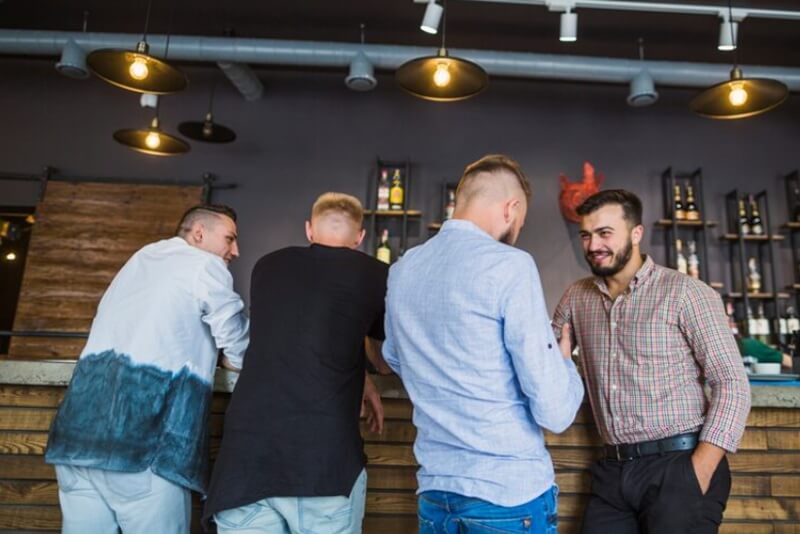
A sort of collective peripheral vision emerges as the standing throng becomes conscious of itself. Everyone is doing sophisticated calculations while keeping half an eye on occupied tables. How full are those glasses? Are jackets being gathered, or is anyone moving in the direction of another round? It takes skill to stand close to a nearly completed table without coming across as predatory. When someone swoops in too forcefully, you’ll hear someone murmur, Some people’ll jump in your bloody grave. It’s competition, but civilized competition the kind with unspoken guidelines that everyone is aware of.
Compare this to Nir Eyal’s description of the sober test, which suggests that if an activity is only enjoyable when drunk, it might not be enjoyable at all. Perhaps not in the way you would anticipate, standing in bars passes this test. It’s the access to spontaneity and the vibrant social energy that makes a good bar feel alive, not the standing itself. It’s true that your tolerance for being bumped by someone’s hip improves proportionately with alcohol consumption, but you can still appreciate it while sober.
| Category | Details |
| **Cultural Practice** | Standing while drinking in pubs, particularly prevalent in the UK |
| **Primary Locations** | Urban pubs, especially in cities like Sheffield, London, Manchester |
| **Peak Times** | Friday and Saturday evenings, post-work happy hours |
| **Legal Variations** | England/Wales: Standing permitted; Scotland: Outdoor drinking must be seated |
| **Industry Context** | Pubs closing at approximately one per week in Scotland (Scottish Beer and Pub Association) |
It has nothing to do with a lack of furniture or masochism to stand in pubs. It has to do with something that is more essential to the whole company. Sitting is settling in, remaining where you are, and establishing boundaries for your little group. Standing allows you to remain mobile, adaptable, and a part of the greater whole of a busy pub. You’re taking part in something shared and a little unpredictable rather than claiming territory.
When you are on your feet, the social mathematics completely change. Over the years, Louise Maclean, who oversees twenty pub sites in Scotland, has observed this dynamic change. Back then, people went to bars to meet new people, not only those they already knew. That’s how she met her husband. Sitting would never make that possible, but standing does. You can turn around, relocate, join a different chat, or see someone on the other side of the room. Try that when you’re stuck in a booth with someone’s handbag obstructing your way out and your coat tucked behind your back.
There’s also a practical aspect, as anyone dumb enough to wear a formal coat on a night out will quickly realize. Either you’re sweltering in it, gripping it uncomfortably, anxiously looking for a coat hook that doesn’t exist, or, more often than I’d like to admit, you’re tossing it on the floor beneath the general throng of feet and beer spills. In this framework, the British custom of wearing shirtsleeves to public events suddenly makes perfect sense. Sure, it’s chilly in between places, but once you’re inside, you’re blissfully free.
A sort of collective peripheral vision emerges as the standing throng becomes conscious of itself. Everyone is doing sophisticated calculations while keeping half an eye on occupied tables. How full are those glasses? Are jackets being gathered, or is anyone moving in the direction of another round? It takes skill to stand close to a nearly completed table without coming across as predatory. When someone swoops in too forcefully, you’ll hear someone murmur, Some people’ll jump in your bloody grave. It’s competition, but civilized competition the kind with unspoken guidelines that everyone is aware of.
Compare this to Nir Eyal’s description of the sober test, which suggests that if an activity is only enjoyable when drunk, it might not be enjoyable at all. Perhaps not in the way you would anticipate, standing in bars passes this test. It’s the access to spontaneity and the vibrant social energy that makes a good bar feel alive, not the standing itself. It’s true that your tolerance for being bumped by someone’s hip improves proportionately with alcohol consumption, but you can still appreciate it while sober.
The way this practice shows how our preferences for social settings have changed throughout time is fascinating. While finishing his post graduate studies, Edward Males works part time in a pub in St Andrews and observes how his peers those who grew up during COVID struggle with the unstructured chaos of a crowded standing room pub. They want to use their phones as security blankets, something to do with their hands and eyes in the event that they are apprehended without engaging with others right away. It feels more and more alien to simply be in close proximity to strangers, open to casual conversation or content observation.
We may be losing, or at the very least changing, the standing pub culture. Twenty two year old Keira McCue wants bars to provide something more than just we’re going for a drink, like a quiz, an event, or an excuse to dress up. Pub standing’s informal, drop in atmosphere isn’t exactly appropriate for a generation that plans ahead and stays in regular communication with friends via digital means. When you already know what everyone is doing on Instagram, there’s no reason to stand around and strike up conversations.
However, healthy bars continue to be crowded with patrons. Observe how the throng moves when one group departs, leaving behind a gust of chilly air and dead leaves scuttling across the carpet. Another group then quickly fills the space. Bodies self reorganize with liquid efficiency. Reaching across, hands pick up pints from the bar. A Scotch egg is balanced on the mantelpiece because there isn’t another surface available. Individuals lean on non leaning walls, sit on laps, and perch on chair arms. Although it appears chaotic, it is actually functional chaos, the kind that denotes vitality.
It’s almost defiant to persist on standing when sitting would be more pleasant. Steve Latto is concerned that younger patrons may enter his pub, notice it is full, and decide not to join the fray. He believes that they no longer tolerate being in close proximity to outsiders and instead prefer safe spaces where their personal space is respected. If he’s correct, venues with guaranteed sitting, bookable tables, and enough space so you never have to make your way through a crowd of people to get to the restroom will likely replace the standing bar tradition.
However, standing continues for the time being at the pubs that are still lively and crowded. It performs the basic function of what bars have always been: public spaces where the barrier between your party and everyone else’s stays permeable, not because Britons are particularly fond of aching feet or appreciate the difficulty of drinking while balancing. Where a stranger might genuinely talk to you, where you might hear something intriguing, where the energy of mankind as a whole, assembled for no other reason than to gather itself, provides something that sitting in tidy, segregated groups just cannot duplicate.
The truth of things is revealed during the changeover phases. See how fast the standing crowd reorganizes when that group eventually gives up their table and moves toward the entrance. It’s not desperate; it’s a habit. And take note of how many of the people who were just seated will soon go back up on their feet due to the underlying restlessness that initially drove them to the pub.
You always get a seat at those beautiful, peaceful pubs? Maybe be concerned about them, as one observer pointed out. Because a bar that is always cozy and doesn’t force you to stand, squeeze, or bargain for space with strangers may be slowly closing. The standing isn’t the issue; rather, it’s evidence that people still desire what pubs have provided for centuries: an unplanned, instantaneous space to be among others, even if your feet complain about it the next day.
i) https://www.blog.tebeau.com/sitting-at-the-bar-vs-table-choice/
ii) https://www.quora.com/Why-do-British-people-like-standing-outside-pubs-while-drinking-beer-Isnt-it-better-to-sit-especially-when-its-cold-outside-or-its-raining
iii) https://www.boakandbailey.com/2018/11/in-the-pub-standing-is-part-of-the-fun/
iv) https://www.bbc.co.uk/news/articles/c9d31xnj9nzo