
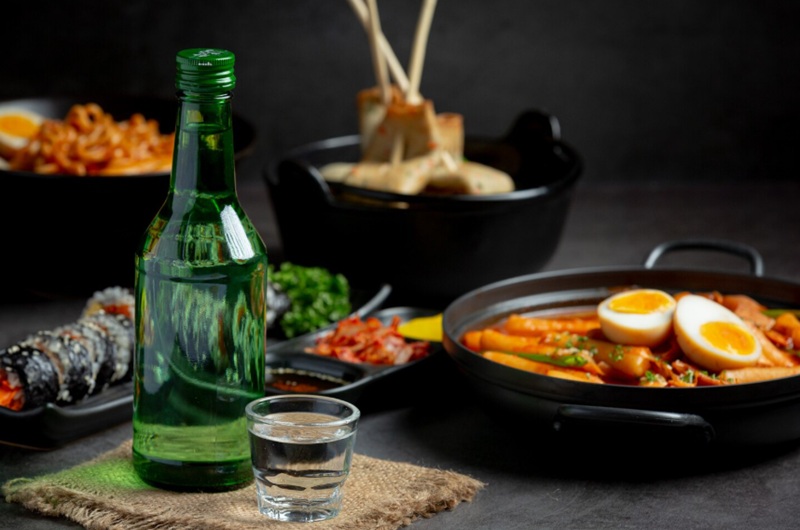
The British pub has an almost obstinate quality. The four lager taps, the wooden bar, the rum bottles gradually growing behind the till, and the gin variety that skyrocketed ten years ago. Then, recently, a green bottle with red letters was placed between the schnapps and the tequila. Soju in Korea. Five years ago, it didn’t exist. Now, it might be, depending on the postcode.
It is simpler to understand the statistics underlying this quiet arrival than the cultural change they signify. In 2024, Jinro, a soju brand owned by HiteJinro, sold 96.8 million nine liter cases, which is more than twice the amount of tequila sold worldwide. For twenty four years in a row, it has been the most popular spirit in the world. The name is unfamiliar to most British drinkers. That’s precisely what’s shrinking the gap between local obscurity and worldwide domination.
Hallyu, the Korean cultural movement that began with soap operas and ultimately rewrote portions of the Oxford English Dictionary, is a part of this. BTS, Squid Game, Parasite, and Tesco’s gradual acceptance of kimchi. The UK currently spends an estimated three and a half billion pounds a year on Korean food. The corn dog chain Bunsik has expanded from a single queue in London to twelve locations, with plans to open fifty four. Walking through Soho on a Friday night gives the impression that Korean eateries are no longer sporadic. For a certain type of evening, they are the standard.
| Key Information | Details |
|---|---|
| Product | Soju (Korean distilled spirit) |
| Origin | South Korea |
| Leading Brand | Jinro (produced by HiteJinro Co., Ltd.) |
| Global Ranking | World’s best-selling spirit for 24 consecutive years |
| 2024 Global Sales | 96.8 million 9-litre cases |
| UK Market Value (2024) | $323 million |
| Projected UK Market (2030) | $441.8 million |
| UK Growth (CAGR, last 3 years) | 73% |
| Typical ABV | 13–17% (flavoured), up to 53% (premium distilled) |
| Major UK Retailers | Tesco, Morrisons, Sainsbury’s, Costco, Lidl |
Soju has done a better job than others at riding this slipstream. Non Asian clients accounted for almost 30% of Jinro’s UK revenues in 2015. Seventy seven percent is the current percentage. Over the last three years, the brand has expanded at a compound annual growth rate of 73%, which is remarkable for a category that was hardly well known in Britain at the start of the plan. It appears that trade analysts consider it as a real breakout rather than a fad.
The product is beneficial. At 13 to 17 percent ABV, flavored soju is more akin to a strong wine than a spirit. In 2026, when drinkers in the UK are consciously moderating, that is important. Among British people who drink, three out of four report reducing their intake. Among those aged 18 to 24, about one in five do not consume alcohol at all. Young people are visiting pubs more frequently and placing various kinds of orders, not because they stopped going. The behavior of switching between alcoholic and non alcoholic beverages throughout the course of an evening is now so widespread that it has a name. Soju, which is flavorful, lower strength, sharing, and intended to be consumed with food, nearly perfectly fills this void.
Most of the store foundation is completed. Jinro Green Grape and Peach is available at over 500 Tesco locations. Morrisons sells it. Sometimes Lidl, Costco, and Sainsbury’s. In March, a food journalist for the Guardian pointed out that Korea’s national beverage is already available in three of the six major supermarkets, seeing this as clear evidence that consumers anticipate its success. The fact that the bottles are still in the World Foods section instead of next to gin and vodka suggests that sales reality still lags behind category perception.
It’s a more difficult pub question. Pubs in the UK closed at a rate of over 400 in 2024 and 366 in 2025. Operators are anxious, business rate relief has been reduced, and margins are being squeezed. Anxious operators also try things. Spirits gained popularity last year, drink led events in pubs are subtly expanding, and gin, the decade’s top beverage, is declining. Someone will fill the void that exists.
Clearly, HiteJinro is wagering it can. After establishing a two story Jinro branded bar at the festival and sponsoring All Points East for three years in a row, the company signed contracts with Wing Wing and Yard Sale Pizza. All of that is not coincidental. Just condensed into a shorter timeframe, it’s the same strategy that Japanese whisky and tequila used to make their way from specialized to mainstream.
The question of whether Soju makes it out of London is less certain. It’s one thing to be among the multicultural, K culture savvy residents of Manchester’s Northern Quarter or Hackney. Another is the wet led pub in a market town. The fundamental issue of how to price a 350ml bottle, staff training, and menu education are all unresolved. According to study by NielsenIQ, 18% of British people had already come across Korean spirits. Incredible. Additionally, 82% have not.
Even still, it’s difficult to ignore the emergence of a category that is likely to solidify. There are already bars for cocktails. The next logical step is for gastropubs to try Korean fried chicken. Then there was the canned and ready to drink style, which would fit unnoticed into pub refrigerators. Most likely, the transition won’t be noisy. It will simply occur in the same manner as gochujang and kimchi did. The green bottle may be unfamiliar one day, but the next it appears as though it has always been there behind the bar, between the tequila and the schnapps.
i) https://nielseniq.com/global/en/insights/analysis/2026/what-does-2026-have-in-store-for-drinks-trends-and-hospitality-operators/
ii) https://www.seoulz.com/korea-soju-industry-2026/
iii) https://www.datainsightsmarket.com/reports/korean-soju-364094
iv) https://www.opentable.co.uk/r/the-soju-reading-2