
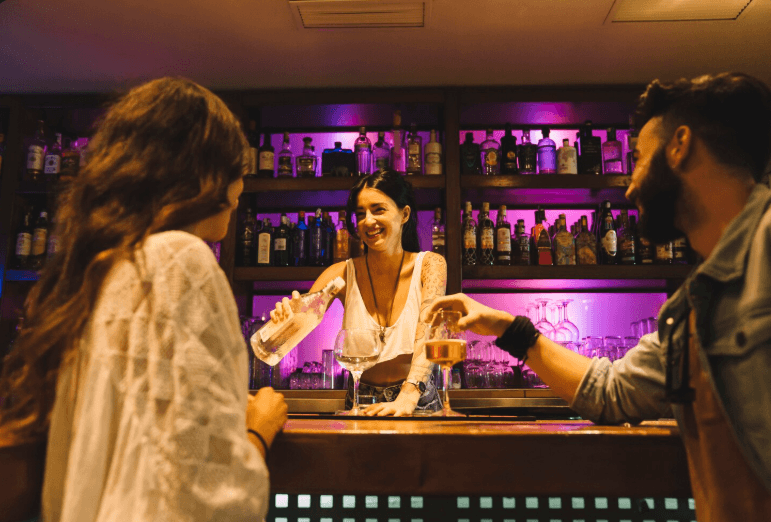
A recently refurbished pub is situated between a tiny grocery store and a series of Victorian terraces on a calm weekday afternoon in East London. The brick façade, hanging baskets, and chalkboard advertising Sunday roast are all still recognizable from the outside. However, there’s a subtle difference when you step inside. The top of the bar is perfectly illuminated. The arrangement of the seats appears nearly mathematical. The sightlines from the door to the taps seem deliberate as well. Interestingly, the proprietors of the tavern claim that a large portion of this design was not created by a single person. It was planned with assistance from an AI algorithm.
AI designed pub decor are becoming more and more common. With design software that can create layouts, forecast client flow, and recommend décor based on data collected from thousands of locations, rather than with robots setting up bar stools or machines selecting wallpaper. A computer predicting where a dartboard should go sounds a little odd at first, but hospitality organizations in Britain and Europe are beginning to test the concept.
| Category | Details |
|---|---|
| Industry Focus | Hospitality Design & Pub Interior Architecture |
| Example Company | Insight Hospitality |
| Founded By | Des McDonald & Olivier Lavigne du Cadet |
| Experience | Over 50 years combined hospitality expertise |
| Headquarters | London, Dubai & Cali |
| Key Work | Hospitality concept development, pub interiors, bar design |
| Industry Reach | Over 150 venues globally |
| Official Website | https://www.insighthospitality.com |
There is some pragmatic motivation. For years, pubs have been under pressure due to growing expenses, changing drinking patterns, and the fact that many consumers now choose a streaming service and a sofa than a busy bar. Owners have started looking for methods to make venues more welcoming after noticing empty tables on slow nights. AI design tools offer an intriguing benefit.
These systems can recommend interior plans designed to maximize comfort and income by feeding in floor dimensions, customer demographics, and sales data. The algorithm may suggest setting up communal tables close to the door, quieter areas in the back, and lighting levels that gently entice guests to remain longer.
According to designers, the program can produce dozens of potential layouts in a matter of minutes; in the past, this process required weeks of sketches and revisions. It’s understandable why operators are interested. AI can turn a nebulous design idea into a visual concept surprisingly quickly, according to Dom Jacobs, a hospitality executive who recently spoke about the technology at an industry roundtable in London. All it takes for a landlord to see numerous floor layouts materialize on screen is a crude drawing and a dream of a cosy neighborhood feel. It may be strangely convincing to watch those renderings change.
The design community is nevertheless a little uneasy. Interior designers have spent decades honing their intuitive sense of color, space, and atmosphere all of which are hard to measure. Some are concerned that software that has been trained on millions of design photos may begin to create technically stunning but oddly generic interiors. Sometimes a place that is perfectly balanced can feel a bit too perfect. A bar owner in Newcastle recently called the AI generated artwork that appears on beer labels overly polished. Although the comment was intended to be critical, it raises a broader cultural issue that is currently pertaining to hospitality design.
What happens when areas start to appear to be machine designed? When you see how the technology actually functions, that question becomes more intriguing. Large image databases of restaurants, cafes, and bars are analyzed using AI design tools. They pick up on trends, such as which seating configurations boost drink sales, which lighting schemes are associated with longer patron visits, and even which colors are most prevalent in successful venues. In the human sense, the outcome is not innovation. It resembles faster pattern recognition more.
However, the outcomes can be very attractive For instance, a cocktail establishment in Singapore recently created an intricate menu inspired by planetary orbit maps using AI generated visuals. The images were odd, abstract, and somewhat scientific. However, clients adored them. Curiosity was piqued by the design, which encouraged visitors to try drinks they might not have otherwise. Lovelty seems to work in the hotel industry.
In Britain, consultants at companies such as Insight Hospitality have been experimenting with AI technologies in the early stages of concept development. The process is still led by designers, but software facilitates rapid testing of layout choices. Before building starts, it can recommend seating density, bar locations, and kitchen flow patterns. hat saves money and time, theoretically However, it’s difficult to ignore the conflict between efficiency and authenticity as the trend develops.
After all, the bar has always been a very human place. Hand painted signage, slightly misaligned shelving, and uneven floorboards are some of the flaws that give venues their unique character. Some worry that when algorithms are incorporated into the design process, certain peculiarities may gradually vanish. ome are not as concerned.
AI is viewed by many operators as just another tool, not as a substitute for designers. A software is capable of analyzing data, but it is unable to observe the peaceful comfort of a warm bulb in the corner when sitting in a pub on a wet night. It is unable to detect the small change in atmosphere when live music starts or hear the whisper of conversations close to the bar Those are still human moments.
Maybe that’s why the majority of leaders in the hotel industry discuss AI with cautious optimism rather than naive enthusiasm. Planning, forecasting, and idea visualization are all made easier with the software. However, the last choices, such as where to hang a mirror, how to curve the bar, and what color to use for the walls, are still typically made by people. and perhaps the industry will find that equilibrium. Sketching possibilities for technology. People pick the ones that feel correct.
It doesn’t feel futuristic to walk through a pub that was partially created by AI. Soft lights, hardwood tables, and the traditional scent of hops wafting from the bar are still present. Someone chuckles by the fireplace. Glasses shatter The environment feels comfortingly normal, if anything which could be the most intriguing result of all.
i) https://www.restaurantonline.co.uk/Article/2025/05/06/how-will-ai-change-hospitality/
ii) https://www.straitstimes.com/life/ai-art-and-flavour-orbitals-how-origin-bar-uses-graphic-design-to-take-patrons-on-a-cocktail-journey
iii) https://www.bbc.co.uk/news/articles/c20jlj26198o
iv) https://smartpubtools.com/ai-meets-ale-how-smart-tech-is-filling-barstools-in-uk-pubs-by-2025/