
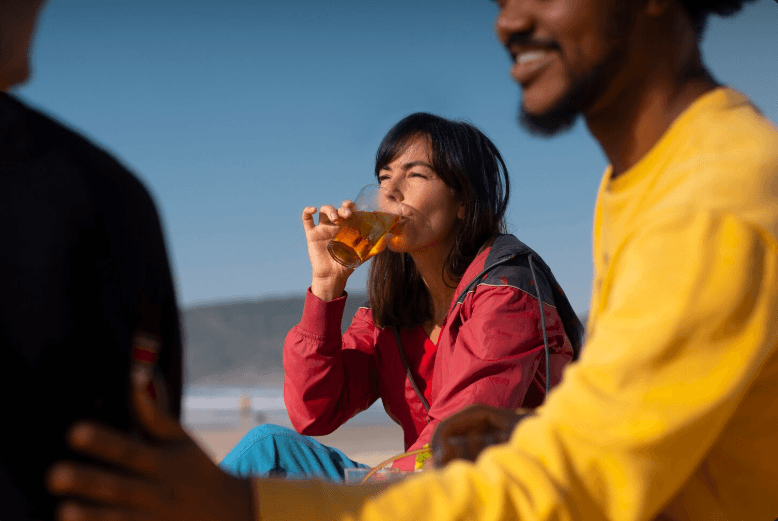
It is typically unintentional when it first becomes apparent. A Sunday afternoon stroll by a pub, with sunlight shining on half empty pint glasses, a couple hunched over a plate of chips, and laughter that seems more subdued than on Saturday night but also more intentional. It’s not a celebration. It isn’t even truly a session.
There’s a feeling that drinking on Sunday afternoons has quietly crept into contemporary culture. Sunday used to have a different vibe, one of reserve, transition, and a gentle landing before Monday. In places like London, it’s starting to feel more like a continuation of the weekend than its end. Not more loudly. Only a moment ago.
| Category | Details |
|---|---|
| Topic | The Rise of Sunday Afternoon Drinking Culture |
| Focus Area | Social trends, generational behavior, hospitality industry |
| Key Demographic | Gen Z and Millennials |
| Geographic Context | UK and global urban centers |
| Industry Impact | Pubs, bars, beverage brands, hospitality |
| Key Insight | Drinking shifting earlier, becoming more intentional |
| Reference Study | GENACIS Cross-Cultural Drinking Study |
This shift is not random, according to the data. People prefer to drink more after 5 p.m. and on weekends, almost as if driven by an internal clock created by work and leisure patterns, according to research conducted in numerous nations. There seems to be a shift in that clock. It is moving ahead rather than vanishing.
There is a generational component to it. Younger drinkers, especially members of Generation Z, appear to be more drawn to controlled social routines during the day and less interested in late night excess. It feels deliberate to have a Bloody Mary at 2:00 PM. For some, having a round of drinks at midnight seems archaic. It’s likely that what’s emerging isn’t less drinking, but rather a different form of drinking that is more about experience than escape.
Groups assembled outside bars as early as midday on a recent Sunday near Broadway Market in East London. Not boisterous. Not rushed. People moved leisurely, as though there was nothing important to do throughout the day. Conversations continued as drinks and breakfast platters arrived. It’s difficult to ignore how different the energy feels from Friday nights’ concentrated intensity.
The business community has also taken note. During daytime events like brunches, festivals, and early dinners, alcohol manufacturers are subtly reinventing themselves. Products are promoted for moments rather than volume and are made for flavor rather than strength. Although it sounds scientific, one marketing executive described it as meeting consumers earlier in their day, and the results are evident. These days, the drink is as much a part of the afternoon as the evening.
Additionally, there is a practical layer. The boundaries that traditionally determined when it was appropriate to drink have been blurred by hybrid employment, flexible schedules, and the decline of the typical 9–5. Sunday nights don’t have the same significance if Monday mornings don’t start with a commute. New rituals have been made possible by this slight but significant change.
Calling this only a lifestyle upgrade would be oversimplified. Beneath it, there’s a subtle tension. Certain drinking periods, especially late nights and early mornings, have long been associated with increased hazards and societal repercussions, according to studies. more recent research indicates that the correlation between timing and injury is less certain than previously thought. It’s not limited to alcohol consumption. It’s with whom and where.
Sunday culture reflects that subtlety. These get togethers frequently take place in public areas, shared tables, beer gardens, and other open, communal settings where the pace is naturally regulated. There is less pressure to stay up and less rush to consume. It’s unclear if this gentler rhythm merely repackages long term dangers or genuinely lowers them.
When you pass a pub at 4 p.m., you might notice someone switching between a full strength pint and a low alcohol drink. This practice is so widespread that it has its own term, zebra striping. It represents a more expansive way of thinking. Not everyone is refraining. They are experimenting, calibrating, and making adjustments.
The venues themselves are part of this experimenting. Pubs, which were formerly known for their sticky floors and late night crowds, are changing to accommodate daytime patrons. These days, menus prioritize food over drink. Where there used to be simply regulars, families now emerge. Certain areas, which offer quizzes, marketplaces, or intimate get togethers throughout the afternoon, have the air of community centers.
Not everyone believes that this is a long term change. Some bartenders describe it as a phase, driven more by economic concerns and post pandemic habits than by a long term cultural reset. Alcohol is pricey. It costs money to go out at night. With its lunch specials and shorter duration, daytime drinking just makes financial sense.
Nevertheless, there’s a sense that something more profound is taking place when you see a group relax into a Sunday afternoon. It moves at a different pace. There are fewer expectations. It feels more intimate and less theatrical. It’s not about staying out as late as you can. It’s about spending a few hours in the present that feel purposefully selected.
It’s still uncertain if this will take the lead in social drinking. Necessary changes are often resisted by cultures. Customs endure. There will always be a space for late evenings. The increase in Sunday afternoon drinking points to a subtle recalibration that prioritizes moderation, timing, and context in ways that earlier generations might not have. That may be the most telling detail. The beverage is still there. It has recently entered the daytime, bringing with it a more subdued and contemplative type of companionship.
i) https://www.businessinsider.com/city-of-london-pub-after-work-drinks-rto-leadenhall-market-2025-12
ii) https://www.linkdood.com/why-day-drinking-is-the-new-pub-trend-in-the-uk/
iii) https://www.thepubshow.co.uk/news/new-research-kam-identifies-new-flexible-drinking-trend-brits