
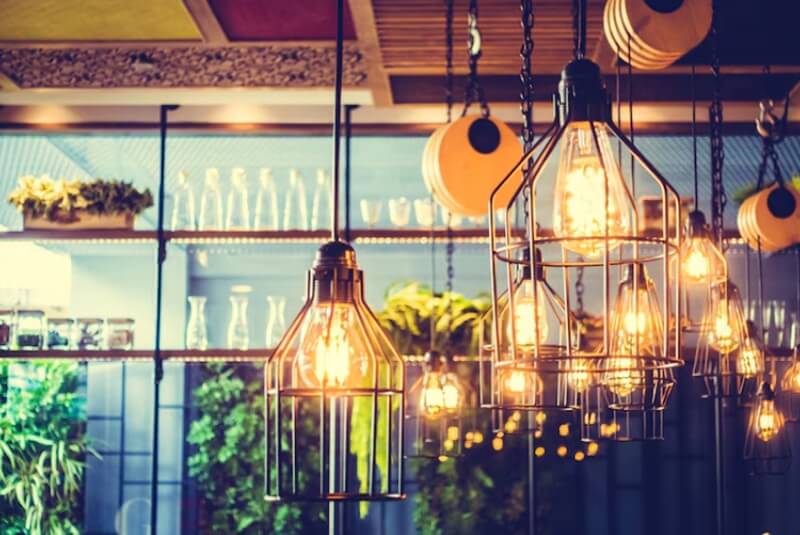
When you enter the incorrect restaurant on a Friday night, you can tell right away that something is awry. The lights above are very harsh. It’s a clinical atmosphere. You leave a respectable tip, eat more quickly without really understanding why, and return to the street feeling somewhat dissatisfied not by the meal, but by something you can’t quite put your finger on. The lighting is most likely that thing.
Once you start paying attention, it’s difficult to ignore how strongly light affects the atmosphere of a room. The quality of a room’s light, including its warmth, direction, and relationship to the surrounding walls and faces, is equally as important as its brightness. One of those design components that operates completely below the level of conscious cognition is lighting. Most people don’t give it much thought. However, their bodies react to it all the time.
| Category | Details |
|---|---|
| Topic | Psychology of Lighting in Commercial & Residential Spaces |
| Primary Field | Environmental Psychology / Interior Design / Behavioral Science |
| Key Researchers | Cornell University (2012 Study on Dining Environments) |
| Published Findings | Journal of Consumer Psychology; Journal of Retailing and Consumer Services |
| Core Finding | Dim lighting increases dessert orders by 300%; appropriate lighting boosts ticket size by 10–15% |
| Lighting Types Studied | Ambient, Task, Accent, Biophilic, Human-Centric Lighting (HCL) |
| Industries Affected | Restaurants, Retail, Hospitality, Office Design, Healthcare |
| Key Concept | Circadian rhythm alignment through tunable and dynamic lighting |
| Relevant Technology | Smart LEDs, Tunable White Systems, Dimmer Controls, IoT-enabled lighting |
| Reference Website | TCP Lighting – Restaurant Lighting Guide |
Surprisingly strong study has been done on this. Even when the meals were exactly the same as those given in harsher lighting settings, a 2012 Cornell University study revealed that diners sat in softly lit areas ate more leisurely, liked their meals more, and rated their cuisine higher. That is an amazing discovery. The cuisine was unchanged. The cost was still the same. The only thing that had changed the entire subjective dining experience was the light. A different study that was published in the Journal of Consumer Psychology discovered that customers were 300% more likely to purchase dessert in dimly lit restaurants. thirty percent. That is a behavioral change brought on by the color temperature of a lightbulb, not a minor influence.
All of this is driven by a system that goes beyond aesthetics and taste. Exposure to light causes actual chemical changes in the brain. The creation of serotonin and dopamine is stimulated by both natural and artificial sunshine, which enhances mood and alertness. The brain shifts into a slower, more gregarious, and less defensive state when exposed to warmer, darker light. These relationships are not soft psychological ones. They stem from the thousands of years that humans have lived under firelight at night and sunlight during the day, which has calibrated human circadian rhythms. Something clicks when a restaurant or retail establishment strikes the correct rhythm. Guests unwind. They stay put. They return to a shelf they passed twenty minutes earlier, or they get another glass of wine.
The restaurant business discovered this long ago, some consciously and some instinctively. Warm, low intensity lighting has become almost universally popular in fine dining restaurants, and it’s not just an aesthetic decision. It is a tactic. Guests remain longer when they are at ease and don’t feel rushed. The check increases as they remain longer. Well calibrated ambient lighting may raise average ticket sizes by ten to fifteen percent and enhance the perceived value of a meal, according to study published in the Journal of Retailing and Consumer Services. That’s a significant income difference made possible by the quality of light falling on a table rather than by personnel or menu adjustments.
It also operates in reverse. Coffee shops and fast casual eateries with significant lunchtime turnover frequently maintain a substantially cooler and brighter atmosphere. Bright, cool toned light increases awareness and speeds up movement. People eat more quickly, have more energy, and move on. That isn’t cynical at all; it’s just the intentional application of biology and physics to a space. Office spaces, hospital waiting areas, and schools are all governed by the same rationale. Human inhabitants and light must interact differently in each situation.
These principles are starting to be used more sophisticatedly in retail environments, especially through what designers now refer to as biophilic lighting, which aims to replicate the layered, rhythmic character of natural sunshine inside a commercial area. The concept is based on a rather obvious fact: areas that use natural light patterns tend to feel more restorative, since people evolved in nature, not behind fluorescent panels. Customers tend to leave a business that feels unpleasant and overbearing. They are encouraged to take their time and peruse one that is cozy, textured, and serene. The most astute retail firms seem to be beginning to recognize this as a competitive advantage in a time when physical stores are struggling to maintain their presence in the face of e commerce, rather than merely as a design preference.
The particular instruments have changed significantly. Lighting designers can now automate progressive changes in color temperature throughout the day using smart LED systems, making it brighter and colder in the morning and warmer and softer as night falls. Certain systems can react to a space‘s occupancy, the weather, or even the kind of event happening there. Dynamic lighting that is tuned to human biology may not be a luxury element in retail and hospitality design, but rather a standard expectation within the next ten years.
However, the extent to which this holds true outside of eateries and retail establishments is currently undervalued. The same rules apply equally to residential settings. Cool daylight spectrum light in a home office seems to improve attention throughout extended workdays. Dimmable, warm toned sources in a living room or bedroom provide true psychological permission to relax. Most people blame everything save the lightbulb over their heads for the low level friction caused by poor lighting, whether it’s too harsh, too dim, or just poorly positioned. It’s probable that this is the root cause of many people’s descriptions of a space not feeling right”.
It becomes evident that lighting isn’t decoration when you observe these ideas in action, such as when a space makes you want to remain and when it subtly nudges you toward the door. It’s not a final detail. It is a space’s principal experience in many significant ways. It filters everything else, including the items on the shelf, the menu, and the furnishings. If the light is incorrect, the rest of the effort is not noticeable. If you do it well, visitors may not be able to articulate why they had such a good time. All they will know is that they remained longer than anticipated. And they will most likely return.
i) https://nanoltg.com/types-of-restaurant-lights-and-lighting-psychology-in-restaurants/
ii) https://rocketpages.io/blog/the-psychology-of-restaurant-lighting
iii) https://www.edwardmartin.com/blogs/information/how-does-lighting-affect-mood-focus-and-daily-productivity
iv) https://www.tastingtable.com/1835017/restaurant-lighting-psychology-dim-lights/