
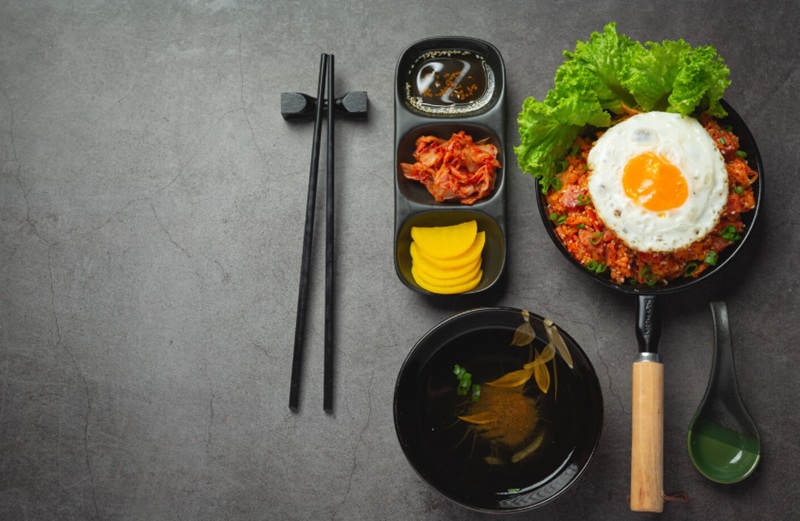
Around eight on a Friday night, the fryer in a busy gastropub kitchen suddenly stops smelling like beer battered cod and takes on a completely different scent, one that is simultaneously sharper and sweeter. This smell, more than any spreadsheet, reveals the true changes that have occurred in British pubs over the past two or three years. This is gochujang. The chicken is double fried and covered in a stop sign colored glaze. Finely chopped kimchi is strewn over a basket of fries that were previously just fries.
This was not an accident, and it’s difficult to ignore how carefully it was constructed. For the past eighteen months, pub owners all over the nation from ambitious gastropubs in city centers to suburban locals have been keeping an eye on Korean food trends with a type of concentrated, almost anxious attention that isn’t typically dedicated to a single cuisine. There’s a reason for that, and it has to do with more than just flavor. The goal is to survive.
| Category | Detail |
|---|---|
| Trend | Korean food and drink integration into British pub menus |
| Key dishes | Korean fried chicken, kimchi loaded fries, gochujang-glazed wings, bao buns, bibimbap bowls |
| Core ingredients | Gochujang, doenjang, ganjang, sesame oil, kimchi |
| Notable UK venues | The Pond (Brighton), Bunsik (London/Manchester), Judy Joo’s Seoul Bird |
| Consumer driver | Younger diners (Gen Z, 18–34) influenced by K-drama, K-pop and social media |
| Trade data source | Bidfood 2026 food trends report |
| Sector context | UK pub closures and rising business rates pressure since 2024 |
The pub industry in Britain has suffered greatly. Due to rising rates, growing labor expenses, and the gradual deterioration of the straightforward wet led business model that was once sufficient, hundreds of pubs collapsed in 2024, and hundreds more followed in 2025. Beer is no longer enough to keep the lights on. Food does that more and more these days, and for many operators, choosing what to put on the plate is now the most important choice they make all year.
It turns out that Korean cuisine addresses a number of these issues simultaneously, which is uncommon enough to be worth considering. Gochujang sales have increased significantly year over year, according to Waitrose, while internet searches for the paste have increased by well over a thousand percent compared to the prior period. Tesco now offers a wider variety of fermented foods. Lidl, Ocado, and M&S have all made similar moves. None of this occurred in a vacuum, and pub owners who looked at those figures appear to have come to the same, rather obvious conclusion: if customers are purchasing gochujang for their home kitchens, they are likely to request it when they’re out.
That’s the subdued reasoning that underlies everything. By definition, pubs are democratic venues. They can’t thrive on menus that seem stale to a clientele that is dwindling yearly, but they also can’t take the chance of upsetting regulars with something too different. Due to supermarket shelves and Netflix subtitles, Korean cuisine has found a really comfortable middle ground where it is both familiar enough to feel safe and unique enough to take good pictures and create a line.
In trade discussions, The Pond in Brighton is frequently cited as an example of this not because it gave up on its pub identity, but rather because it didn’t. With the addition of Korean BBQ wings, bao buns, and kimchi filled chips, it transformed a somewhat unremarkable neighborhood restaurant into a destination that younger people will travel to. The notion of Judy Joo’s Seoul Bird chicken is growing. In just a few years, Bunsik has expanded from one location in London to seven, with lines outside that pub marketing teams seem to be starting to admire rather than copy.
Why this specific food has become so popular while others have not is virtually generational in nature. Generally speaking, Gen Z drinkers are more difficult to reach than their parents ever were. They are less interested in the typical three course pub dinner, more inclined to order based on what will look nice in a fifteen second video, and more eager to travel for a venue that has gone viral. The gloss of a glaze, the crackling of a chicken wing cracking open on camera, and the sheer visual anarchy of a shared banchan dish are all examples of how Korean cuisine is almost designed for this. A dish of fish and chips, no matter how delicious, just doesn’t do well on a phone screen.
It’s likely that this is just the most recent in a long line of culinary trends that bars have followed and then subtly abandoned. Cupcakes, sliders, and pulled pork were all popular at one point. Operators who have experienced those prior waves seem to notice a difference here. Korean cuisine is not just dependent on innovation. It’s connected to K pop, K drama, K beauty, and an entire cultural ecology that doesn’t seem to be slowing down. Trends that are rooted in something that big typically endure longer than those that rely on a single dish to be intriguing.
Speaking with professionals in the field, it’s remarkable how low the barrier to entry has become. No pub needs a wood fired oven or a sushi counter. The double fry method for Korean chicken is handled by a typical fryer. An average kitchen crew may easily obtain marinades and glazes. These days, foodservice providers deliver frozen bao buns that simply require steaming. Compact gochujang, doenjang, sesame oil, garlic, and kimchi make up the ingredient list, which is getting easier Korean obtain through mainstream distributors rather than specialty imports.
The most astute operators are not viewing this as a box to be checked. Tim Bird, whose Cheshire Cat Pubs and Inns business won the 2025 Publican Awards’ Best Food Offer category, has discussed concentrating on a narrow core menu rather than following every fad. Rather than a complete rebranding into something the kitchen can’t maintain, that is essentially the paradigm that is currently evolving throughout the industry: one or two well selected Korean dishes anchoring the regular menu, with seasonal specialties doing the rest of the work.
Watching this develop across menus from Manchester to small market towns gives me the impression that the bars doing it correctly aren’t just throwing kimchi onto a burger and hoping. They are the ones whose chefs have actually taken the time to figure out why the kimchi ferments the way it does and why the chicken is fried twice. Customers, even those who are unable to articulate why, seem to notice the difference when this wonder appears on the plate.
It’s really unknown if this lasts for another five years or disappears like the novelty of craft beer did. For the time being, however, Korean cuisine has offered bar owners something more than a fad: a cause to think that the next patron may genuinely be anticipating what’s on the menu in an industry where remaining steady has become a type of danger.
i) https://swlondoner.shorthandstories.com/the-rise-of-korean-food-in-the-uk/
ii) https://www.williammurray.co.uk/2024/04/08/korean-flavour-fever-the-trend-thats-sweeping-the-uk-culinary-scene/
iii) https://cateringinsurance.co.uk/2025/08/20/keeping-up-with-current-trends-in-uk-restaurants/
iv) https://tastewise.io/blog/uk-menu-trends