
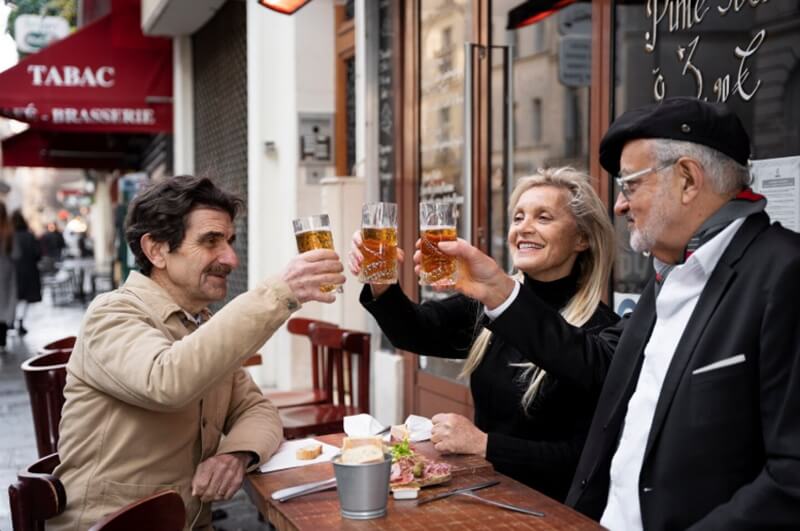
On a weekday in central London at half past four, the bar stools remain unoccupied, the glasses are polished but unused, and the bartenders are leaning slightly against the counter, seemingly anticipating a cue. Then the room moves, almost subtly. A gang emerges from a nearby office, their jackets unbuttoned and their laughter barely audible. After half an hour, the space comes to life. It’s neither evening nor work yet. There’s a cost associated with that intermediate condition.
In Britain, happy hour has always been more than just a sale. It’s a meticulously planned occasion. he fundamental paradox persists. After work, more people want drinks, thus demand rises, but prices decrease. The reverse would be suggested by classical economics. However, it becomes evident that there is more going on as you witness two for £12 cocktails slide across the counter in a Soho bar. Alcohol is not the only product.
| Category | Details |
|---|---|
| Topic | The Economics of Happy Hour in Modern Britain |
| Industry | UK Hospitality & Beverage Sector |
| Key Organisation | Nightcap Plc (UK Bar Group) |
| Notable Figure | Sarah Willingham (CEO, Nightcap) |
| Market Trend | Price sensitivity, cost-of-living impact, dynamic pricing |
| Economic Context | Post-COVID recovery, inflation pressures, reduced discretionary spending |
| Estimated Market Behavior | 55% of UK consumers spending less in bars |
| Reference Website | https://www.thespiritsbusiness.com |
It’s difficult to ignore how this fits in with more general concerns. It’s not exactly a carefree moment in Britain. Energy bills fluctuate, inflation persists, and nights out have subtly evolved from an urge to a deliberate choice. According to surveys, almost half of British customers are cutting back on their bar spending. That number is like a low ceiling over the industry happy hour still exists, though. even flourishes in some areas.
You can understand why if you go into Covent Garden on a Thursday night. Bright, rather disorganized calligraphy is used on chalkboards to advertise sales: 2 FOR £10, SPRITZ SPECIAL, and 4 to 7 PM ONLY. The urgency is purposeful. Time limit. narrow window. Every offer contains a psychological prodding.
Happy hour may be effective because it gives an otherwise pricey setting a fleeting sense of value. At 9 p.m., paying £6 for a cocktail might seem exorbitant, but at 5 p.m., it seems nearly reasonable. The real savings are less important than that change in attitude.
The model is still under strain. Rent, employment, and ingredient expenses have all increased, squeezing margins. Discounts are not as common as they were ten years ago. Alternatives are being secretly tested by several venues. less hours of joy. lesser savings. Or, in a slightly unnerving twist, the complete opposite strategy.
The model is flipped by unhappy hour, as some have begun to refer to it. Instead of decreasing during slow times, prices climb during moments of high demand. After 10 PM, a pint that costs £7 in the afternoon may start to approach £9. In terms of economics alone, it makes sense. For years, ride hailing apps and airlines have done this. It feels different, though, in a pub. private. Nearly obtrusive.
Clients have taken note. Some believe it is unavoidable. Others object to the concept, labeling it as opportunistic. The tension implies that pubs function in a more emotional environment than airlines. Pricing is about fairness, or at least how it is seen, rather than merely efficiency.
In the meantime, the week’s actual format has changed. The classic Friday rush has been weakened by remote work. Thursday has subtly emerged as the new hub for drinking after work. Saturdays are now more important as well, with planned events and brunches taking the place of unplanned evenings.
Bars have had to change due to this restructuring of time. Happy hour has evolved beyond a 5 p.m. routine associated with work life. It’s dispersed, adaptable, and occasionally even themed bottomless breakfasts, early evening gatherings, and midweek specialties created to cover previously unfilled spaces.
As you see all of this, you get the impression that happy hour is more about coordination than drink. It synchronizes people into the same location at the same time, including strangers, friends, and coworkers. The discount is only the catalyst.
How long this equilibrium can last is still up in the air. Costs keep going up. Customers continue to be wary. The distinction between expectation and motivation becomes increasingly hazy. Happy hour used to feel like an added perk. These days, it feels virtually essential in some locations. nevertheless, the identical pattern reappears at six o’clock. The space expands. Glasses shatter. Discussions cross over. The economics are at least temporarily forgotten for a few hours.
i) https://www.meer.com/en/90347-from-prohibition-to-present-happy-hour-phenomenon
ii) https://www.economist.com/leaders/2025/07/10/britain-is-cheap-and-should-learn-to-love-it
iii) https://www.theguardian.com/money/2024/nov/18/happy-hour-in-reverse-where-dynamic-pricing-may-creep-further
iv) https://www.euronews.com/culture/2023/09/14/sobering-thought-uk-pubs-introduce-unhappy-hour-surge-pricing