
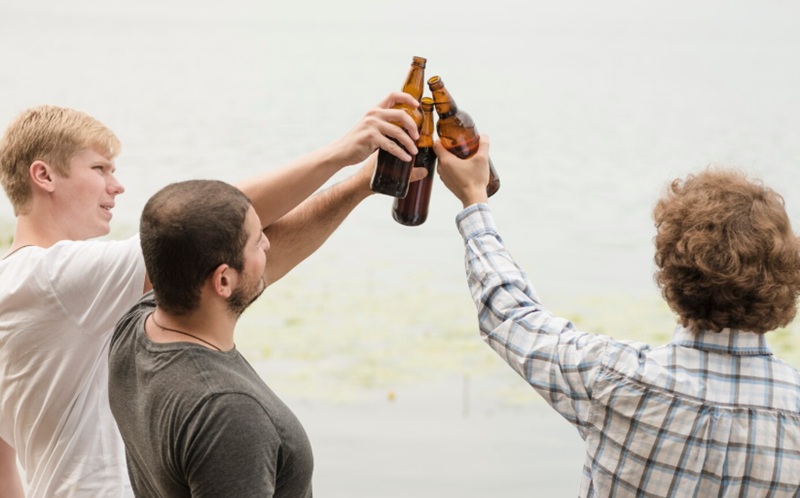
The second week of January is when a certain type of British custom takes place. While their pals go about their serious business of drinking, the Dry January holdout, a little bored and self satisfied, nurses a sparkling water in the pub. For a long time, the main purpose of alcohol free beer was to provide this person with a courtesy and a method to go through the month without showing signs of religiosity. With the zeal of a parking lot receipt, Beck’s Blue emerged from the rear of a filthy refrigerator, slightly warm. That was the category’s position in British society for decades. A placeholder for a season. A January item.
That story is now over, and it is difficult to dispute the numbers that concluded it. By the end of 2025, 200 million pints of no alcohol and low alcohol beer were predicted to be consumed in the UK, according to the British Beer and Pub Association. This is a nearly 20% increase over the previous year and accounts for over 3% of the country’s entire beer market.
| Category | Details |
|---|---|
| Sector | No & Low Alcohol Beer (NoLo) |
| UK Market Volume (2025) | 200 million pints (record high) |
| Year-on-Year Growth | ~20% (2024 vs 2023; 2025 vs 2024) |
| Market Share of Total UK Beer | ~2.7–3% |
| Growth Since 2013 | ~750% volume increase |
| Market Value (Low & No Alcohol) | £413 million (Mintel, 2025) |
| Consumer Adoption | 45% of UK adults tried low/no alcohol drinks in past 12 months (Drinkaware, 2025) |
| CAGR Forecast (2024–2028)** | ~7% (IWSR) |
| Key Players | Guinness 0.0, Heineken 0.0, Lucky Saint, Peroni Nastro Azzurro 0.0, Stella Artois 0.0 |
| Industry Body | British Beer & Pub Association (BBPA) |
Since 2013, the category has had a 750% increase in volume. Between 2024 and 2028, volumes of the entire no alcohol market are predicted to increase at a compound annual growth rate of 7%, with no alcohol beer now making up more than 2% of all beverage alcohol market sales in the UK. These numbers do not represent a January novelty. They represent something that has undergone irreversible transformation.
The simplest answer is that the items improved. For many years, the most popular way to make alcohol free beer was to brew a regular beer and then use heat to extract the alcohol, which eliminated around half of the beverage’s flavor. The end product was thin, somewhat cardboardy, and fine enough if you had no other option. Subsequently, a generation of craft brewers, like Big Drop in London, Nirvana in Leyton, and Lucky Saint with its German lager, made the decision to base their beers on their lack of alcohol instead of adding it later.
The product’s advancements were so significant that the category’s previous reputation started to seem more like a relic from the past than a contemporary grievance. The perception of the entire category changed when Diageo introduced Guinness 0.0 in late 2022 and it genuinely tasted like Guinness. Seeing the draught handle of a Guinness 0.0 being pulled in a London pub makes it difficult to ignore how commonplace the behavior has grown.
Luke Boase, the founder of Lucky Saint, put it simply: the brand has become ingrained in people’s drinking habits, and record sales now occur every month of the year. The historic emphasis in January has given way to a significantly more even pattern of consumption. The word that is deeply ingrained in people’s drinking habits is crucial. It distinguishes between a shift in behavior and a trend. Trends come and go. Behavior is a compound.
The category’s escape from January can be better explained by social factors than by technological ones. According to Aviva data, 48% of British people intended to reduce their alcohol use in 2025. This number increased to 61% for those between the ages of 18 and 24 and 68% for those between the ages of 25 and 34. Alcohol has been subtly repurposed as something to be managed rather than just consumed by the health culture that popularized gym memberships and sleep trackers. For younger British drinkers in particular, it seems that having a physical or social hangover has become a burden rather than a badge of honor. In ways that no public health campaign could truly do on its own, the “hangxiety” phenomenon that particular contemporary dread of checking your phone the next morning has focused minds.
Supermarkets saw this change and took action. After seeing that the sector was expanding at a rate of over 20% annually, Waitrose established separate alcohol free sections with eye catching blue signage in over 250 stores. Mintel calculated that the market value of low alcohol and non alcoholic beverages was £413 million. As of 2025, 53% of adults in the UK report having had low alcohol beer, wine, cider, spirits, or cocktails in the previous 12 months. Nearly half of alcohol consumers now frequently consume both standard and low alcohol beverages. The traditional dichotomy of drinkers and non drinkers has mostly vanished. The majority of individuals fall somewhere in the middle, and the category now offers enough variety and quality to keep them there.
The on trade change has been just as important. Almost 25% of Greene King’s 1,600 managed pubs now serve an alcohol free beer on tap, while overall sales of alcohol free drinks increased by 36% over the last 12 months. It is worthwhile to focus on the draught detail. British beer culture has always operated on a draught basis. Alcohol free ceased to be a consolation prize and became a legitimate choice when it began to appear not only in refrigerators but also in typefaces at the bar. No explanation was needed to order it anymore.
While the entire beer category had a 1% dip in 2025, non alcoholic beer volumes increased by 8%. Premium plus beers performed particularly well, making up 29% of the category as opposed to 20% in 2019. Alcohol free beer is expanding while normal beer is dropping, and premium beer is leading the way inside alcohol free. This juxtaposition accurately conveys the larger picture. When a customer choose Guinness 0.0 or Lucky Saint, they are not giving up anything. They are choosing carefully, giving it the same consideration as they would any other high end beverage.
Whether the regulatory environment will catch up fast enough to reflect what has already transpired commercially is still up in the air. Many British brewed goods are left in a labelling grey area that benefits no one because the UK still defines alcohol free as 0.05% ABV, a threshold much tighter than the 0.5% standard used across much of Europe and beyond.
In order to align the UK with worldwide norms, the UK government pledged in its Ten Year Health Plan for England in July 2025 to consult on raising the upper strength requirement to 0.5% ABV. The industry has been waiting for this consultation for years, and when it finally results in a change, it will make sense of a confusing landscape and allow smaller brewers to more directly compete with the global brands that already operate under more lax definitions elsewhere.
The more subdued cultural normalization that has been the driving force behind all of this is not completely reflected in the numbers. Alcohol free beer was always presented in the Dry January story as something you had to endure.
Nowadays, many buy it in twelve packs with their regular beer, store it in the refrigerator carelessly, order it in the middle of the week because they have an early start or run the following morning, or just because they feel like it. According to a January 2026 YouGov survey, almost one fifth of alcohol consumers who tested low and no alcohol substitutes claimed that doing so had decreased their overall alcohol use. The product is more than a January filler. Britain’s drinking habits are gradually shifting as a result of it.
In every category, that is a significant change. It’s noteworthy in beer, one of the most ritualized and culturally charged categories in British consumer life. Now, the dusty back refrigerator is far behind. More than anyone could have predicted, the January placeholder has expanded into something far bigger and more permanent.
i) https://www.beveragedaily.com/Article/2025/07/25/uk-alcohol-free-market-definition-data-and-statistics/
ii) https://www.theiwsr.com/insight/the-uk-no-alcohol-market-key-statistics-and-trends/
iii) https://www.ibisworld.com/united-kingdom/industry/non-alcoholic-beer-production/14687/
iv) https://nielseniq.com/global/en/insights/analysis/2025/how-moderation-is-changing-the-uk-beverage-basket/