
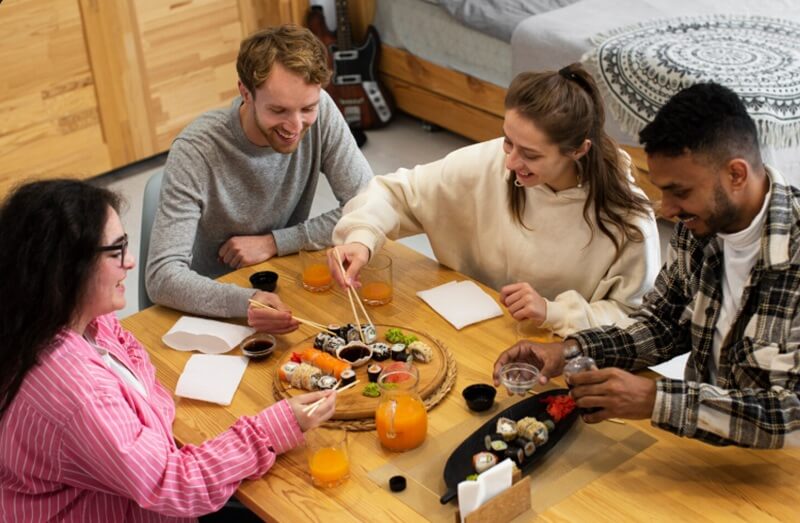
he moment a plate touches down in a dining room the atmosphere shifts. Faces turn hands loiter and forks pause. A neighbor receives the first spoonful from someone. Does anyone want the last dumpling? inquires another. It’s a small ritual but it tilts the table’s energy from individual appetite to group judgment from parallel eating to shared choreography.
That choreography differs greatly between nations. People in Latin America and the Caribbean say they share nine meals a week with Senegal reporting an astounding 11.7 social gatherings for almost every lunch and dinner. Conversely South Asia and some regions of East Asia report far fewer shared meals a conclusion influenced by aging populations an increase in single homes and potentially disparities in the definition of someone you know. There is more to the pattern than just wealth or hours worked. There’s a feeling that the table is treated like a private workstation in certain locations
| Item | Details |
|---|---|
| Topic focus | How sharing plates shifts behavior, trust, and conversation at the table |
| Key global stat | Latin America and the Caribbean average ~9 shared meals/week; Senegal tops 11.7; Bangladesh and Estonia near 2.7 |
| U.S. trend | In 2023, about 1 in 4 Americans ate all their meals alone the previous day; up ~53% since 2003 (American Time Use Survey) |
| Wellbeing link | More shared meals correlate with higher life satisfaction and lower loneliness across regions |
| Cultural note | Shared dining central in tapas bars, Chinese banquets, Ethiopian injera spreads; rising “supper club” formats in the UK/US |
According to the American Time Use Survey one in four Americans up more than half since 2003 reported eating all of their meals by themselves the day before in 2023. That is a scheduling issue rather than a moral shortcoming. However it also means that many people seldom engage in the complex discussions that shared plates require such as listening to others’ preferences timing a bite to ensure the food is consumed and budgeting appetite while keeping others in mind.
Even though science is still in its infancy it continues to push in the same direction. . People cooperated more in variations including shared bags of crackers not because they felt closer right away but rather because sharing produced a sense of coordination. The brain’s endorphin systems which are released after a run or a good laugh can also be triggered by eating the same food at the same time. A passing bowl may be synchronizing a group in addition to providing food.
As you watch eateries adapt you can tell that the concept is becoming more popular than merely trendy. Once constructed as checklists of protein starch and vegetables menus are now more loosely organized into sets of plates intended for circulation. A entire roasted fish a dented bowl slick with tahini and lemon and a brass pan with blistered peppers appear. With mild guidance staff members bend in and say Order a few to start and add as you go. The room gets noisier in a way that sounds like people inhaling tables stretch and plates overlap.
The void left by hectic lives has been filled by organized group dinners. These events which include midweek supper clubs long tables reserved for strangers and three course menus designed to pass the time rely more on purpose than taste. When guests arrive they are aware that everyone else is there to socialize. The structure itself handles the difficulty that arises in adult friendships around who initiates contact and who follows up. It’s difficult to ignore the amount of departing employees who are already haggling over the next meal.
All of this is not new in terms of culture. In Kuala Lumpur round tables with Lazy Susans keep everyone equally away from the good food; it’s customary to serve others before yourself. Spanish tapas bars use waves of tiny plates to pace discussion and as hunger wanes and conversation takes control the night goes on. With the delicate ritual of hand feeding a friend Ethiopian injera transforms the entire meal into a single shared surface. Cuisine is not the unifying factor. The impulse is leveling. The towering entrée that denotes status vanishes at a communal table. Together people create the evening piece by piece.
Frictions exist. Sharing plates necessitates a little more preparation and attention due to dietary requirements religious restrictions and allergies. Concerns about germs persist particularly after the pandemic. A plate grabber at some tables eats swiftly allowing others to recalibrate and grin courteously. By drawing attention away from the table phones can short circuit the chemistry when they creep back next to cutlery. None of these are lethal.
The benefits feel tangible though. Shared plates reduce the space between strangers practicing small talk while slowing down a meal just enough to allow the conversation to get deeper. The final piece of steak turns becomes a test of kindness. To continue the discussion the second round of flatbread becomes a vote. It’s still unclear if sharing plates strengthens bonds between people or just makes them more like themselves. In any case the format encourages the group to be better.
All of this has a subtle pragmatism to it. People report less loneliness and greater social support in nations where shared meals are more common. Sometimes it’s just soup and bread with one other person; not every evening calls for a large feast. However a family style platter feels more like a toolset than a fad at a time when eating alone is becoming more common and social infrastructure continues to deteriorate. Place an order that you can divide. Place it in the middle.
i) https://www.worldhappiness.report/ed/2025/sharing-meals-with-others-how-sharing-meals-supports-happiness-and-social-connections/
ii) https://www.glassandvine.com/posts/the-philosophy-behind-shared-plates-and-communal-dining
iii) https://www.bhs-tabletop.com/en-en/blog/post/shared-dining-community-is-trending/#/
iv) https://www.psychologytoday.com/us/blog/the-modern-heart/201909/the-hidden-power-of-a-family-style-meal