
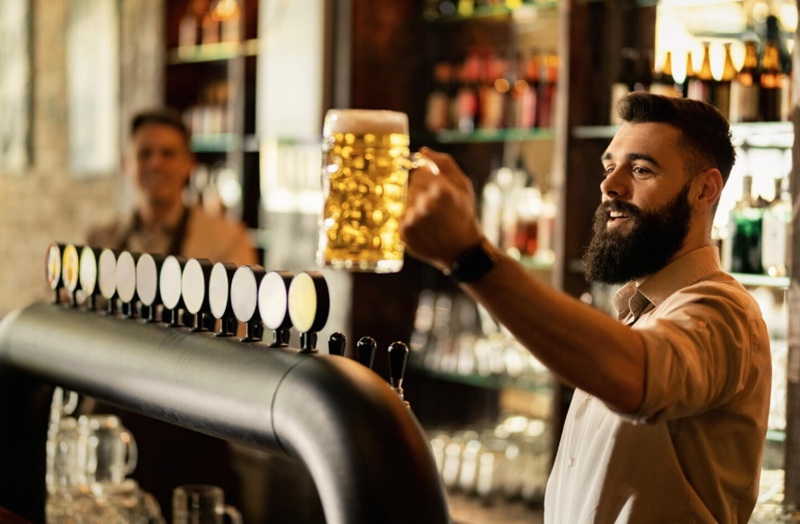
When you walk into a bar on a Friday night in 2025 in Brooklyn, Philadelphia, or Chicago, your attention is drawn to something before the menu. It is not a list of cocktails. On a chalkboard, this isn’t a craft IPA. Across the bar, a pint of Guinness Dark is still settling in the hands of a person who appears to have found the establishment only a month ago. The white head is slowly lowering itself toward the small printed harp on the glass. Twenty years ago, in an Irish pub on Chicago’s South Side, this detail would have seemed normal. These days, it feels like a statement in a natural wine bar in Chinatown, Manhattan, or in a Crown Heights brunch establishment promoting Taco Tuesday.
It is more difficult to ignore the numbers supporting that claim than anyone in the beer business anticipated. According to Nielsen data that is frequently used in US trade press, Guinness became the fastest growing imported beer in the US based on bar and restaurant sales throughout the 12 months leading up to December 2024. This expansion coincided with a decline in the total volume of beer produced in the United States, which is a crucial distinction for distributors who are attempting to decide where to invest their funds. Global Guinness sales increased by 13% in fiscal 2025, according to Diageo, after rising by 15% the previous year. For a product that is 265 years old, consecutive double digit growth is not something that happens by accident.
| Guinness — Key Information | |
|---|---|
| Full Name | Guinness Draught (Diageo plc) |
| Founded | 1759, St. James’s Gate, Dublin, Ireland |
| Parent Company | Diageo plc |
| Global Daily Sales | Over 10 million pints sold per day worldwide |
| ABV | 4.2% (Guinness Draught) |
| Calories | ~125 per 12 oz serving |
| US Breweries | Open Gate Brewery, Baltimore (2018); Open Gate Brewery, Chicago (2023) |
| Global Growth (FY 2025)** | 13% net sales growth; 15% the prior year |
| North America Net Sales (FY 2024)** | +6% amid overall beer volume decline |
| Non-Alcoholic Version | Guinness 0.0 — grew 161% between June 2022 and March 2025 |
| Irish Pub Concept | Launched 1996 in US; 1,800+ pubs opened in 53 countries; 99% success rate claimed |
Keg orders seem to be the answer to the issue that most people are asking: is Guinness driving the pub renaissance or is it just profiting from it? Between 2022 and 2025, Fergie Carey, a native of Dublin who had operated Fergie’s on Sansom Street in Philadelphia for thirty years, increased the number of kegs she poured each week from about ten to twenty. Over a two year period, Guinness sales in Chicago increased by 40–50%, according to the co owner of the Kerryman. By 2024, the majority of the patrons at Mike O’Sullivan’s bar Hartley’s in Brooklyn were no longer Irish men in their fifties, and Guinness was sold at a six to one ratio over everything else on the menu.
A pub game that no one at Guinness invented deserves part of the credit. In order to split the G, a drinker attempts to keep the foam line precisely in the center of the G in the word Guinness on the glass after taking the first sip of a freshly poured pint. Before it made its way to TikTok in late 2022, the behavior had been practiced for years in Irish and British pubs. Split the G searches reached their peak on Google Trends in the US by late 2024. Over 684,000 people liked a combined attempt by Ed Sheeran and Niall Horan. The Jonas Brothers, Paul Mescal, and Jason Momoa shot the versions. The fad was not an official campaign, according to Guinness’s own brand spokesperson. Ironically, the statement gave it a more genuine vibe. New York bar managers recounted seeing parties place rounds with the express purpose of filming the effort, failing, and placing another order.
The arrival of that social media loop coincided with the remarkable rise in popularity of Irish culture in America. Award nominations were being gathered by Paul Mescal and Cillian Murphy. As the first Irish singer songwriter to top the Billboard Hot 100 since Sinéad O’Connor in 1990, Hozier’s song “Too Sweet” did so in 2024. The Dallas Bomb Factory was sold out by Fontaines D.C. A piece about how the Irish came to dominate pop culture appeared in New York magazine. While performing in Dublin, Olivia Rodrigo donned a “Guinness is Good 4 U” shirt. When he lived in County Donegal, Oran McGonagle, the man who founded the Dubliner in Boston, observed that the beer was hardly fashionable. The irony of Ireland exporting cool back to itself via an American renaissance is difficult to ignore.
Correcting a misconception that had existed for decades also contributed to the conversion. A lot of Americans thought Guinness was hefty. Something thick, like a meal in a glass, was suggested by the black color and the creamy nitrogen pour. Through the same TikTok videos where the split the G challenge was taking place, the reality 125 calories, 4.2 percent ABV, lighter than a typical lager circulated naturally. The creators superimposed the calorie amount over words. Younger drinkers demanded a second pint after trying it and being shocked. There was never a Guinness advertisement with the health conscious framing. Thousands of fifteen second video taken in bars around the nation included it.
The new Irish bar that will open in American towns in 2025 and 2026 will have a different appearance than its predecessor. Jen Murphy, a native of County Mayo, decorates Banshee in the East Village of New York with artwork by local artists and serves Guinness with oysters, an ancient Irish beach pairing. The Wren in Baltimore, which was included in the New York Times’ and Bon Appétit’s lists of the finest new restaurants for 2025, is devoid of speakers and televisions. The only sounds in a traditional Irish pub, according to co owner Millie Powell, are conversation and the sound of a pint being poured. Alongside the stout, McGonagle’s in Boston serves wood fired pizza and Irish Chinese spice packets. Guinness beef stew and Nigerian style chicken suya are served at the Open Gate Brewery in Chicago. These aren’t prefabricated themed taverns. They are, or are attempting to be, more thoughtful.
The proportion of this that belongs to Guinness as a brand versus Guinness as a symbol a drink that came in the right glass at the right time is still up for debate. What is more certain is that the moment was made possible by the company’s decades of silent infrastructural construction. The Irish bar Concept was introduced in the United States in 1996 and provides prospective bar owners with free operational support and design advice. In a sector where 80% of venues fail within the first year, Diageo boasts a 99 percent success rate. On a 62 acre old distillery property in Baltimore, the Open Gate Brewery opened its doors in 2018. In 2023, a 10,000 pound harp sculpture and a bakery that donates 200 loaves of brown bread per week to the Greater Chicago Food Depository were added to the Chicago brewery. These are not advertising gimmicks. These are the kind of investments that have a ten year payback period that subtly strengthen a community presence, a quality culture, and a distribution network.
A new dimension has been added by Guinness 0.0. Between June 2022 and March 2025, the non alcoholic version increased by 161 percent. According to a 2025 government poll, 25% of Dublin’s population presently consumes non alcoholic beverages. Pubs that serve Guinness 0.0 on draft attract pregnant patrons, designated drivers, and sober curious patrons who still desire the pint glass ritual and social acceptance to return for another round. Jack McGarry, who quit drinking ten years ago and founded The Dead Rabbit in New York in 2013, said he doesn’t enjoy the dichotomy of drinking and not drinking. The contemporary Irish bar no longer asks patrons to decide between participating and abstaining by providing both options.
This narrative also has craft beer weariness. A certain type of American drinker became tired of their own beer order challenging them after fifteen years of ever higher ABV pastry stouts and hazy double IPAs. Guinness is reliable, easily available, and less expensive than most artisan beers about nine dollars per pint in Chicago and eight to ten dollars in New York. In a pub scene full of moving taps and seasonal releases, that consistency has a subtle charm. You are aware of what you’ll get. The phrase “everyone is drinking Guinness” that Mike O’Sullivan used in Brooklyn continues coming up as we see this unfold city by city.
i) https://www.morningadvertiser.co.uk/Article/2026/01/08/pub-sales-soared-while-restaurants-suffered-in-christmas-2025/
ii) https://www.insighttrendsworld.com/post/insight-of-the-day-british-pubs-are-worried-they-ll-run-out-of-guinness
iii) https://edition.cnn.com/2024/12/15/business/guinness-shortage-concerns-britain
iv) https://www.cnn.com/2024/12/15/business/guinness-shortage-concerns-britain/index.html