
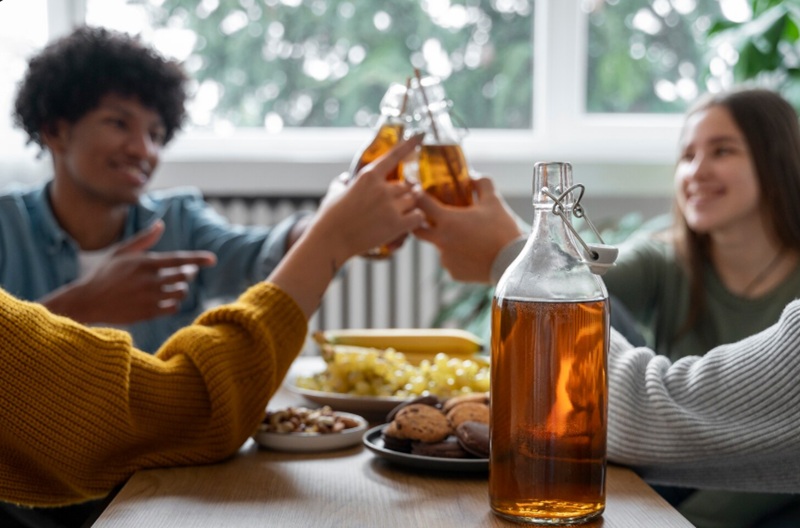
When someone orders a pint in a British pub, usually about eight on a Friday, the barman doesn’t ask if they mean it’s devoid of alcohol. He merely spills it. More can be learned about this category’s position in 2026 from the tiny lack of a query than from any sales figure.
For many years, alcohol free beer in the UK was synonymous with a weak apology that was ordered out of need rather than want and sat next to the actual lagers. That isn’t true anymore, or at least it isn’t true as it once was. The refrigerated shelf area devoted to 0.0 and 0.5 percent beers has expanded from a few bottles to what looks like an aisle when you walk into a Tesco or Waitrose these days. It’s difficult to ignore how unconcerned people appear about it, how commonplace it is to witness a stranger sipping a Heineken 0.0 at a football game or a Guinness 0.0 at a wake without anyone making a comment.
| Category | Detail |
|---|---|
| Market size | Over 300 individual alcohol-free beer SKUs now listed across major UK specialist retailers |
| Top-rated lager | Heineken 0.0, scoring 89/100 in independent testing, stocked in roughly 92 percent of UK supermarkets |
| Best overall (2026) | Lucky Saint, named best overall alcohol free beer by IndyBest |
| Best stout | Guinness 0.0, brewed at St James’s Gate using cold filtration |
| Best hazy IPA | Bero Edge Hill, founded by actor Tom Holland after his 2022 Dry January |
| Price range | From 62p (Aldi own-label) to roughly £3 per premium craft can |
With good reason, Heineken 0.0 is still the most well known brand on that rack. It retains the citrus brightness and honeyed malt that testers at the Good Housekeeping Institute praised when they put 75 beers through a blind panel during the winter. It is brewed in the Netherlands using the same yeast strain as regular Heineken before being dealcoholized through vacuum distillation. There’s a reason BBC Good Food referred to it as the finest of the major brands rather than merely the most accessible, as it received the highest score of any tested lager, 89 out of 100. It is not flavor engineered. The best description this category can get is that it tastes like someone forgot to add the booze.
A rather different story is told by Lucky Saint, which has evolved into a small scale industry case study. The speed at which a beer made in Germany using just four ingredients Pilsner malt, Hallertau hops, water, and a specially created yeast convinced the notoriously cautious drinking public in the UK that 0 percent could mean anything other than compromise is truly astounding. The Independent’s tester acknowledged double checking the label. That’s a journalist questioning her own taste, not marketing copy. It has also become the go to option for anyone counting macros without wanting to feel penalized because it has sixteen calories per 100 milliliters.
Then there’s Guinness 0.0, which resolved an issue that appeared to be unsolvable for a very long time. According to traditional thinking, mouthfeel is crucial for stout, and mouthfeel is strongly influenced by alcohol. The St. James’s Gate brewers at Diageo disagreed, using cold filtration instead of distillation to retain the proteins that give the beer its thick, persistent head. In one independent test, five out of seven blind tasters accurately recognized it as Guinness. The coffee bitterness is present, as is the two minute head retention that stout drinkers value above all else. It’s a little sweeter than the original and slightly thinner if you’re paying close attention.
With 92 points, Bero Edge Hill Hazy IPA took first place in the Good Housekeeping rankings, which is noteworthy considering that three years ago, the brand hardly existed. It would be simple to write it off as a celebrity vanity endeavor after Tom Holland’s own Dry January, but the testers were blind and had no idea whose name was on the can. A hint of elderflower, a juicy orange, and a sharp finish that prevents it from being too sweet. It’s unclear if that will continue as the brand grows, but at the moment it’s winning on taste rather than notoriety.
The opposite technical approach is taken by St Austell’s Proper Job 0.5, which is brewed via restricted fermentation rather than stripped afterwards. Cornwall residents enthuse about it with the same ferocity, loyalty, and mild possessiveness that they do about a decent local chippy. Alcohol Change UK gave it a five star rating. Several testers were persuaded that Mash Gang’s Chug IPA, which is lighter and grassier, might be full strength.
Additionally, budget buyers have not been excluded. Aldi’s Pilsner 0.0, which costs 62 pence per bottle, received 77 points in the same Good Housekeeping test, demonstrating that price and quality aren’t as closely related as they once were in this category. With its undertones of banana and clove, Maisel’s Weisse dominates the wheat beer market. This serves as a gentle reminder that German brewing customs translate very well into zero percent format.
It’s not really unclear what’s causing all of this. According to Alcohol Change UK’s Dry January data, 65% of participants reported improved health and 70% reported better sleep. Heineken, Diageo, and AB InBev have all promised to include low alcohol and non alcoholic products in a fifth of their portfolios; most have since achieved this goal. It probably doesn’t matter if that’s sincere appetite or deft placement. The beer in the glass tastes nice, and more and more people at the bar seem to be focusing entirely on that.
i) https://www.theguardian.com/food/2018/sep/09/adrian-chiles-top-10-alcohol-free-beers
ii) https://www.independent.co.uk/extras/indybest/food-drink/beer-cider-perry/kate-middleton-non-alcoholic-beers-b2941677.html
iii) https://www.goodhousekeeping.com/uk/food/food-reviews/g29867278/non-alcoholic-beer/
iv) https://www.mydrybar.com/alcohol-free-beers/