
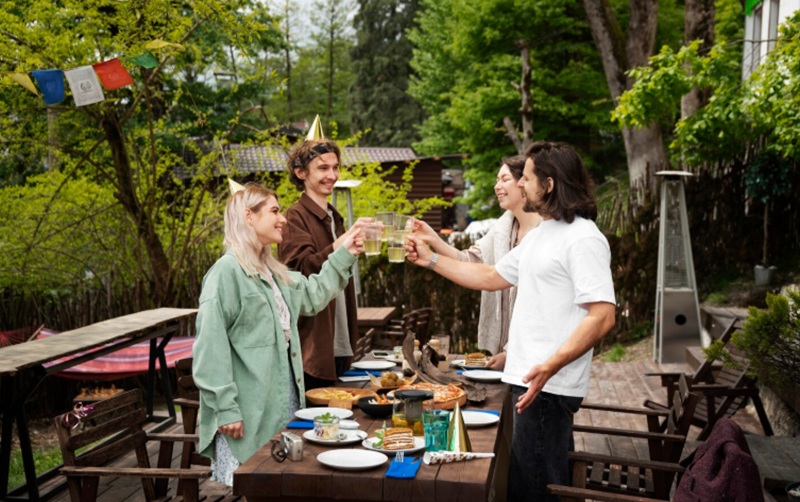
A big table in a refurbished Victorian pub garden does what dining tables at home can’t on a Saturday afternoon in June in the Home Counties. Two dogs strewn across the small shade, grandparents dressed in linen, a child tearing up a sausage bun, and an adolescent who, against all chances, has put down the phone for four minutes. Someone asked for pale ales. Sparkling elderflower was ordered by someone else. Even though it’s just three o’clock, a pizza oven is being heated up at the end of the grass, and fairy lights are woven between the branches. Nobody hurries. It’s empty inside. One of the more subtle social trends of the past 25 years is that a British family meal is increasingly being held in a pub garden instead in a dining room.
It makes sense when you think of the pub garden. For the most of the 20th century, it was merely a worn lawn with a few wooden seats where you went to smoke in between rounds or get some fresh air on Friday evenings when the pub was too noisy. The pub was a smoke filled, male dominated establishment that served embarrassing food, such as ploughman’s, pickled eggs in jars on the bar, or scampi if the chef felt daring. Children were either left outside or tolerated. Most licensees would have thought it absurd for a family to eat a long Sunday lunch in a bar garden.
| Detail | Information |
|---|---|
| Topic | The cultural transformation of British pub gardens into family dining destinations |
| Time Period | Approximately 2007–present (post-smoking ban era) |
| Key Catalyst Events | UK smoking ban (2007), gastropub revolution (1990s–2000s), COVID-19 pandemic (2020–2021) |
| Industry Body | British Beer & Pub Association (BBPA) |
| Landmark Venue | The Eagle, Farringdon, London widely credited as Britain’s first gastropub (est. 1991) |
| Key Statistic | Approx. 4 in 10 people cite the beer garden as the primary driver of their summer pub visit |
| Alcohol-Free Trend | Roughly 1 in 3 adult pub visits now involves no alcohol |
| Outdoor Licensing | Streamlined pavement licensing extended post-pandemic to support urban venues |
| Geographic Focus | United Kingdom (England, Scotland, Wales) |
Food did not break the order first; regulation did. The UK’s 2007 smoking ban in enclosed public places is rightly seen as a public health measure. It was also perceived by the licensed trade as an unintentional catalyst for the revitalization of outdoor areas. Once customers were prohibited from smoking inside, thousands of licensees began using their gardens and pavements as floors for sales. Awnings lifted. There were patio heaters. There were benches with shade.
Seasonal overflow was transformed into year round profits by enterprising businesses. The ambience of the tavern was another, less obvious but possibly more significant change. Before prohibition, pubs were primarily frequented by men, but as the atmosphere cleared, women and families felt comfortable using them, according to the shopkeepers. A small social movement that was currently scarcely perceptible hinted at something more significant.
The gastropub revolution was already transforming British taverns. New proprietors reopened In 1991, The Eagle opened on a corner in Farringdon, London, with the straightforward but self assured concept of serving Mediterranean inspired dishes written on a chalkboard in a true beer bar. The model detonated. In a matter of years, the term “gastropub” became commonplace, and Sunday roasts were transferred from the family home to the saloon bar. By the time they had kids, it felt more normal to take the whole family out to lunch at the neighborhood restaurant rather than prepare a roast for eight in a subpar kitchen. A generation had grown up expecting food to be integral to a pub visit, not incidental.
A large portion of the shift took place indoors during the first two decades. What smoking bans had partially accomplished on outdoor spaces, pandemic did. Venues may only trade outside when England came out of lockdown in April 2021. The result was unsettling and happened right away. According to one industry tracker, drink sales on a Monday in April more than doubled on the first day despite the snow. Mid spring Christmas level trading was reported by publicans. After being apart for months, families could finally legally rejoin in the bar garden. Overnight, it was the most sought after square footage in Britain.
Then came the permanent part. More than ever, bar owners made investments in their gardens. Heated pergolas and dining pods appeared. There were wood fired pizza shacks and outside pubs. Festoon lights, children’s play areas, wildflower plantings, and fire pits turned boring lawns into purposeful lingering locations. Customers and licensees were hesitant to give up on the investment once restrictions were removed. Thanks to simplified pavement licensing, urban establishments can now set up tables on streets and squares without months of municipal deliberation. The British custom of staying outside to eat and drink was broken, at least.
Nobody anticipated that the pub garden would turn into a family area as a result. When you think about the alternative, the appeal is obvious. Smaller homes, the loss of the formal dining room in newly constructed buildings, longer workdays, and the practicalities of feeding a big gathering while staring at a kitchen that looks like it was hit by a bomb have all contributed to the decline of the traditional Sunday meal at home during the past several decades.
A restaurant solves the cooking issue, but it also adds reservations, three course pressure, the fear of a drowsy kid in a quiet area, and a bill that may cover a week’s worth of groceries. The discrepancy is almost precisely balanced by pub gardens. Delicious food without being expensive. It’s less expensive than dining out. Noise, clutter, pets, and dropped ice cream are all acceptable in this setting. On a Sunday afternoon, the structure’s flexibility arrive at noon and go at four if you’d like is just what a stressed out family needs.
Sociologists may also identify the third location, which is the neither home nor work environment where community develops. After the war, Britain’s third places quickly declined. The working men’s club, country pub, and high street cafe became less prevalent as car culture, television, and home leisure became privatized.
The third spot for contemporary families has almost unintentionally returned thanks to the modern beer garden. Unlike most contemporary spaces, it is multigenerational, public without being impersonal, and communal without needing participation. Babies, teenagers, young couples, elderly acquaintances, birthday parties, and a lone reader with a book and a pint on a warm afternoon will all congregate in a well kept garden for a softly buzzing communal setting. Contrary to popular belief, that is more valuable and rare.
The extent of the drink’s degradation is also apparent. It would have shocked previous licensees to learn that one in three adult bar visits are now alcohol free. As family and afternoon visits have grown in popularity, so too have low and no alcohol beers, ciders, and spirits. There is now an adult alternative to a pint or lemonade for a parent who is heading home with children in tow or having lunch rather than a session. It feels natural to spend an afternoon without booze outside with other people. The garden demonstrates how rapidly the tavern has changed.
The revolution is not unbeatable as a result. British pub economics has never been more difficult. Rent, business rates, energy, food, and wages have all surged. A quarter of bars turn a profit. Unprepared for the garden revolution, smaller, drink focused community pubs with no outdoor space or food offerings have kept closing. The family’s Sunday outing budget is impacted by the fact that a pint that cost three pounds ten years ago now costs over four pounds nationwide and over five pounds in London. For those who could afford to invest, the pub garden boom was a story of survival; for others, it was a tale of obsolescence.
From a distance, the trajectory is breathtaking. A smoking ban was converted into a trade area by a health ordinance. A pub movement brought food outside after British dining patterns changed. The garden was the only option following a pandemic, and its routines were too vital to give up. A dynamic family culture finds its perfect setting despite temporal and multigenerational space limits.
Inadvertently, the beer garden evolved into the family dining room: open to the public, friendly, food driven, dog friendly, year round, and physically unable to leave a pile of laundry. One of the most striking and mostly positive changes in modern society. The dining room has moved outdoors and is now open to the public, as seen by the long tables that fill up every Saturday in June. It is not wanted to be moved back.
i) https://madeofbits.co.uk/blogs/news/outdoor-dining-pods-the-next-big-thing-in-the-hospitality-industry
ii) https://tasteat55.co.uk/2022/10/11/garden-bars-growing-in-popularity-due-to-cost-of-living-crisis/
iii) https://togethermoney.com/blog/post-pandemic-garden
iv) https://northnorfolknews.co.uk/news/how-move-outdoors-has-helped-norfolk-pubs-restaurants-8219332