
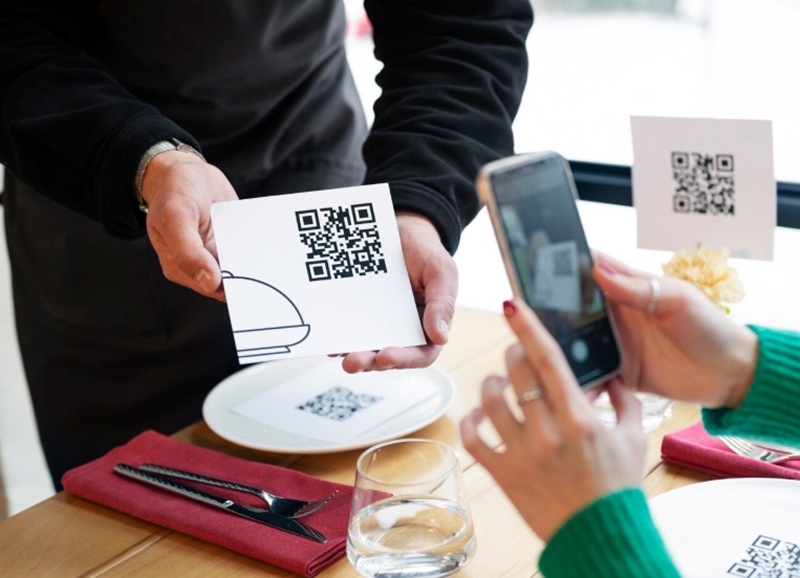
Many diners are familiar with this situation. A laminated card with a black and white square appears once the table is pristine and the room is filled with the aroma of delicious cuisine. You pick up your phone. Open it up. It feels longer than the meal you were hoping to enjoy after holding the camera at the proper angle, waiting for the focus to settle, tapping the notification, and arriving at a webpage that loads in three seconds. Your conversation has turned into two people staring at separate screens by the time the option arrives because the person across the table has already completed the same action on their phone. Exactly, nothing has gone wrong. Something is off.
The QR code menu was made out of necessity. When British hospitality reopened following the initial pandemic lockdowns, it appeared frightening as dozens of strangers passed a physical menu between tables. For eateries that needed a contactless solution fast, the QR code was accessible, affordable, and didn’t require new technology. By summer 2020, the little square was everywhere: glued to café counter corners, laminated onto pub tables in the Midlands, and propped against salt shakers in Soho bistros. For a moment, it felt like progress.
Five years hence, would it still work? According to business statistics, research studies, fraud reports, and surveys, more and more British diners are refusing. The Journal of Hospitality and Tourism Management revealed in late 2024 that the perceived hassle of QR code menus affected customer loyalty when compared to traditional menus. Technomic analysts also found that 86% of Gen Z respondents preferred paper menus, which surprised observers who thought younger diners would be eager converts. According to a PYMNTS Intelligence and Paytronix survey, only 31% of customers enjoyed utilizing a QR code to browse a menu. More than 60% of respondents said they found QR menus annoying. These numbers are not provided by winning technology.
| Topic Overview | |
|---|---|
| Subject | QR Code Menus in UK & Global Hospitality |
| Technology Type | Digital menu delivery via QR (Quick Response) code |
| First Widespread Adoption | 2020 (pandemic-era rollout across UK, US, Europe) |
| Key Industries Affected | Restaurants, pubs, casual dining, hospitality |
| Primary Concern | Eroding customer trust, security vulnerabilities (quishing), accessibility failures |
| Key Statistic | Only 31% of consumers feel positively about QR menus (PYMNTS Intelligence / Paytronix) |
| Fraud Data | ~1,386 quishing incidents reported in the UK in 2024; up from ~100 in 2019 |
| Notable Voice | Sir Tim Martin, Chairman of JD Wetherspoon, publicly questioned QR ordering’s effect on pub culture |
| Academic Reference | Journal of Hospitality and Tourism Management*, 2024 — QR menus found to reduce customer loyalty vs. printed menus |
It’s crucial to be precise since trust isn’t being lost suddenly. There are no boycotts, walkouts, or viral protests. Compared to a string of minor complaints that seem insignificant but build up, the decline is more gradual and cumulative. Because she didn’t scroll far enough, she missed an entire portion of the drinks list. An older restaurant with an unfocused phone camera in dim light. Watching a loading spinner is a Berlin traveler without a UK data plan. Letters to the editor are not written by any of these individuals. But whether a place is worth going back to depends on those impressions across thousands of meals a week.
Things have become much more acute due to the fraud component. The UK’s national fraud and cybercrime reporting center, Action Fraud, has been issuing increasingly urgent warnings about stopping QR phishing for the past two years. In this type of scam, a criminal overlays a fake sticker on a legitimate code to divert the scanner to a convincing counterfeit website that steals payment information. These numbers are no longer unimportant. In 2024, Action Fraud received 1,386 quishing reports, compared to just 100 in 2019. The monthly average increased more than 50% in the first quarter of 2025.
Quishing is the fastest growing payment initiation attack in the EU, according to Europol’s 2026 organized crime threat assessment. Because casual scanning has made consumers less vigilant, pubs, restaurants, and parking lots are the most often targeted. Before entering payment information, Action Fraud advises customers to verify the connection, the URL against the restaurant’s address, and the sticker for tampering. There is now a checklist for a technology that promised frictionless access.
Most diners might not follow that checklist. A lot won’t. But they’ve heard enough to make them uneasy, and mistrust is a problem in and of itself. A restaurant finds it difficult to tell a customer that their code is secure after learning about QR fraud. While technology in the wrong hands can undermine trust, the majority of eateries have done nothing wrong.
Sir Tim Martin, chairman of JD Wetherspoon, is an odd representative for the cultural argument. Wetherspoons pioneered QR ordering in UK hospitality when it launched its app in 2017, and its 815 pubs continue to be significant examples of integrated digital ordering in British pub culture. Martin appeared to agree that QR ordering was “taking away the atmosphere of chatting with the bar staff” in his answer to a customer complaint in the company’s magazine. He asked, “What’s a pub visit without shooting the breeze with the bar team?” He added that he had always thought the app would fail because of this and that time would prove him correct. He was kidding, the firm explained. He might be. But the joke in his own newspaper encapsulates the idea that one of the few really social encounters in British society has been discreetly destroyed by digital ordering. While they are not required to deliver a drink to a table, the bar line, the fleeting conversation with the pint puller, and the chance conversation with a stranger are what characterize a pub. The tavern feels flatter now that they are gone, but it is still a pub.
The same loss is seen differently by restaurants. Eating out has always included holding the menu, talking about what to order, asking the waitress questions, and selecting wine. When a phone screen is used in its place, a shared item becomes two private ones, and a supper becomes parallel solitary scrolling in the same space. In 2024, Teddie King, director of operations at the high end London restaurant Zuma, stated that QR code menus were “a little bit tacky” in the restaurant business. Although this statement would have remained inside the sector, it is already having an impact on how operators portray themselves.
I sense that the industry is responding hesitantly. Paper menus have been covertly reinstalled by many 2020 digital only businesses. The hybrid idea, which uses a QR code by default and offers paper menus upon request without bias or condemnation, is intriguing. Real time menu modifications, allergen filtering, reduced print run costs, and improved customer data are among recognized operational advantages of digital ordering. These advantages are genuine, particularly in the case of allergy compliance, which has become considerably more difficult since Natasha’s Law began in 2021. For a customer with a severe allergy, a well designed digital menu that instantly filters products by allergen is vital and challenging to replicate on a static card.
“Well built” is overworked in such statement. In UK venues, a lot of QR menus link straight to a PDF of the printed menu. This is the worst implementation, with no digital advantages and all digital hassles. Some are responsive, but they load slowly, have complicated navigation, and conceal large menu areas behind buttons that users never see. It’s possible that the diner’s phone experience was not tested by the operators who swiftly implemented these systems in 2020. Observing this throughout the industry, it appears that the best implementations of the technology have been unfairly singled out and that a large portion of the criticism is focused on the worst applications rather than the technology itself. The crossfire is real, but it is also understood.
There is a gap in the QR menu. It is too useful in too many situations to go away, and it will probably remain in fast casual contexts where ceremony is subordinated to speed. But the blind faith that the small square would transform meal ordering in 2020 has faded. Operators will succeed if they recognize that dining out is a social ritual that benefits from human attention, invest in functional interfaces, treat digital ordering as one option in a thoughtful system rather than as a replacement for human service, and make printed menus available without making customers feel guilty for wanting one. That doesn’t have to be impeded by technology. But it needs to know where it is.
i) https://www.dineopen.com/blog/free-qr-code-menu-uk-restaurants.html
ii) https://www.dailymail.co.uk/yourmoney/article-13481891/Restaurants-ditch-annoying-menu-trend-backlash-starting-alienate-people.html
iii) https://sundayapp.com/en-gb/common-barriers-to-adopting-qr-codes-in-restaurants-and-how-to-overcome-them/
iv) https://www.inquirer.com/food/qr-code-restaurant-menu-20220104.html