
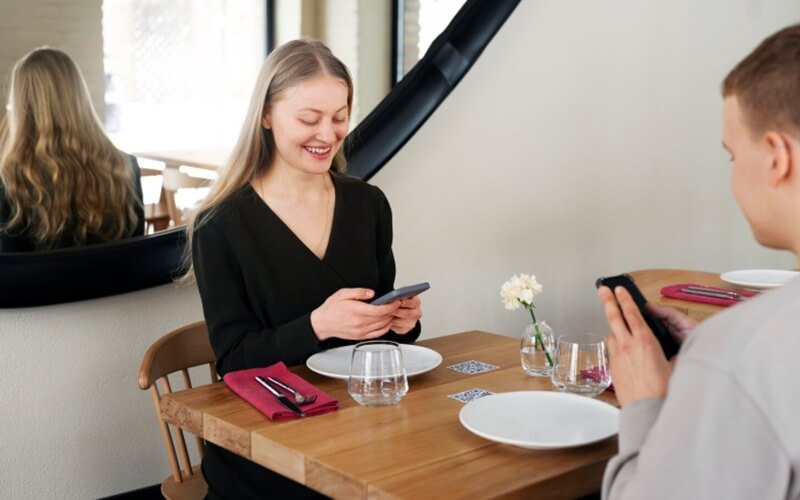
The first thing you notice when the host informs you it will be 30 to 40 minutes on a Friday night is their manner which is a special blend of practiced calmness and apologies. You grab the pager find a little piece of wall to lean against and browse through your phone with the kind of restless hunger that turns minutes into elastic lengths of expectancy. You have the strange realization that you are almost enjoying this at minute twenty two. The sound of glasses clinking beyond the partition and the scents that drift out of the little entrance each time a server pushes through the swinging door all indicate something. By the time you take a seat and start eating the food is quite tasty. The dilemma is whether the kitchen deserves all the credit or if the wait service has achieved something the chef could never have.
A limited body of research suggests that the solution to the problem at the intersection of sensory psychology and hospitality management may be more complex than most restaurant owners realize. After distributing questionnaires to real consumers rather than respondents from hypothetical scenarios she used arrival rates and service time data to simulate actual waiting times. One of the simpler findings was that when perceived wait times were longer than what they considered appropriate consumers’ evaluations of dependability a crucial part of the SERVQUAL model dramatically declined. Neither the ambiance nor the seeming warmth of the staff suffered. It was the sense that you could count on the business to keep its promises. Long incomprehensible pauses not only annoy people but they also quietly erode their faith in the success of the subsequent action.
| Category | Details |
|---|---|
| Primary Research Source | “Waiting Experiences in Online Restaurant Reviews” by Baek and Choe (2025), published in the Journal of Korean Marketing Association |
| Pioneering Study | Carolyn Lambert’s cafeteria study at a large Northeastern U.S. university, using SERVQUAL and Arena simulation |
| Core Framework | Expectancy Disconfirmation Theory (Oliver, 2010); the value of time and psychological discounting |
| Critical Finding | Waiting longer than expected reduces satisfaction far less than waiting shorter than expected increases it — by a factor of more than 1.6. This asymmetry reverses only when wait time estimate comes directly from the business or when the delay exceeds roughly twice what was expected. |
| Industry Blind Spot | 91% of surveyed store managers believed the opposite, overestimating the damage of a longer-than-expected wait |
| Real-World Example | Disney deliberately overstates ride wait times so guests consistently experience a shorter wait, creating a small, recurring delight |
| Reference Link | https://doi.org/10.53728/2765-6500.1649 |
But the final choice made by a diner is rarely a simple subtraction. Regina A. a Yelp reviewer gave it five stars while noting that she had to wait longer than expected: Service could be a little faster but the food is very very tasty. The relationship between delay and total enjoyment is statistically modulated by affect. A pleasurable twenty five minutes in a brightly lit lounge with a complimentary glass of water is completely different from an irate twenty five minutes in a dimly lit hallway.
Then there is the paradoxical imbalance which calls into question the accepted knowledge about queue management. Three behavioral experiments that coupled scenario trials with real waiting scenarios found that waiting less time than predicted increases happiness more than 1.6 times more than the satisfaction loss caused by waiting more time than anticipated within reason. The procedure appears to be a type of psychological time discounting. Customers who lose an extra two or ten minutes cognitively undervalue those minutes in order to make the purchase feel fair once more (after all what was I really going to do in that time anyway?).
When someone unexpectedly gains time there is no such devaluation; rather the gift feels significant. 200 store managers were polled and 91% of them stated that waiting longer than expected had much more negative effects than positive ones. They can be missing out on easy victories because of their faulty instincts.
There is always a catch and it is the threshold. When a delay surpasses roughly twice the expected duration psychological discounting breaks down and discontent rapidly rises. This is the point at which a certain entertainment giant’s stunt becomes educational. Disney parks publicly exaggerate wait times so it seems like a small triumph when twenty two actual minutes are compared to an advertised forty five.
For the course of the visit this pattern produces a number of joyful microemotions. When restaurants subtly inflate their time estimates and inform a walk in party that it will take 35 minutes when the actual wait is probably 25 they are essentially employing the same technique. It’s possible of course that someone will glance at the number decide it’s too long and turn away. No risk no reward.
Other aspects are directly under the control of the front of house management. As it occurs the moment someone decides to stay lunch begins. Waiting between the promise of a table and the actual arrival of food is unnecessary. The brain’s reward systems start getting ready for the flavors to arrive during this period which causes expectations to solidify and appetites to increase.
Watching all of this from a barstool next to the host stand makes it hard to ignore how little of the evening is really about the food alone. While the kitchen is straining over precise temperatures and reductions the front of the house is concurrently stirring something equally potent altering the diner’s internal state long before the first forkful. If the industry were to learn one thing from the study it might be that managing expectations is a crucial element in and of itself rather than the second best strategy to reduce clock time. According to the report not many people are actively utilizing this emotional potential.