
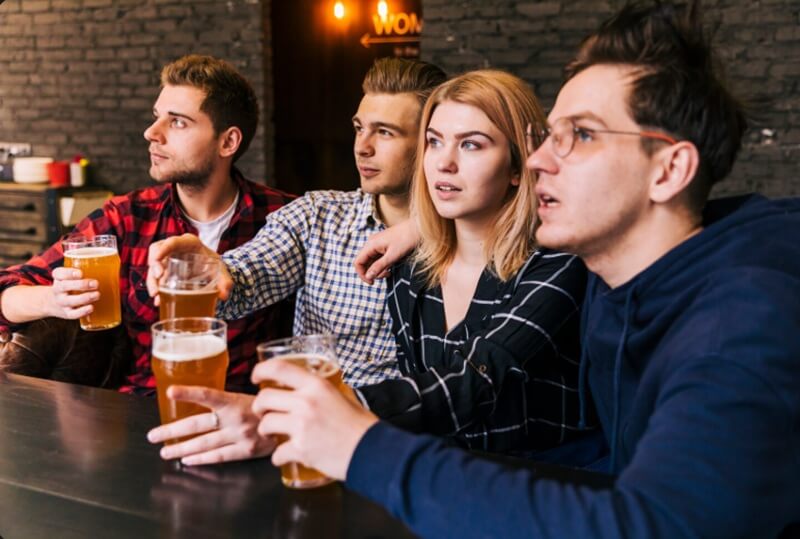
There is a moment somewhere around the second round of drinks when something quietly shifts. Two people who arrived as complete strangers different jobs different postcodes possibly different countries are suddenly leaning toward each other laughing about something one of them said finishing each other’s sentences. Nobody planned it. Nobody scheduled it. It just happened the way things tend to happen in pubs.
This is not a coincidence. It’s not entirely the alcohol either though that’s often the first explanation people reach for. Something deeper is at work inside these slightly dimly lit faintly sticky floored environments that humans keep returning to generation after generation. The pub it turns out is one of the most effective social bonding spaces ever constructed and most people walking through the door have no idea.
| Category | Details |
|---|---|
| Topic | Social Psychology of Pub Environments and Temporary Friendships |
| Primary Setting | Traditional pub and bar environments, particularly in the UK and globally |
| Key Psychological Concepts | Oxytocin release, group identity, shared experience bonding, psychological generosity |
| Related Research | Study published in Adaptive Human Behavior and Physiology (2021) |
| Cultural Significance | Pubs have served as community anchors in British culture for centuries |
| Key Social Mechanisms | Ritual, humor, small talk, active listening, shared challenges |
| Population Affected | Adults of all ages, particularly men’s friendship formation |
| Loneliness Context | Loneliness in American and British populations has reached epidemic levels |
| Economic Impact | Average Briton spends approximately £90,942 in pubs over a lifetime |
| Reference | https://www.thecrawlco.com |
Consider a scene observed at a village pub not long ago: a man in his fifties clearly a recent arrival to the area sitting at the corner of the bar making polite but slightly strained conversation with a bored young bartender. Then another man walked in with a dog. He ordered a pint and crucially stayed at the bar to drink it rather than retreating to a quiet table with his newspaper. Within minutes a question about the dog’s breed had turned into a conversation about living in the village which turned into a formal handshake a muttered exchange of first names and eventually two men buying rounds for each other. By the time anyone noticed they were deep in something that looked very much like friendship. It was genuinely a moving thing to witness.
A 2021 study published in Adaptive Human Behavior and Physiology confirmed what that pub scene suggested: social activities like going to the pub are crucial to developing intimate friendships particularly for men who tend to prefer group based interaction over one on one conversations. Shared history the research found is a key ingredient in male friendship intimacy. The pub almost by design manufactures shared history in real time the bad joke someone told the match that went to penalties the round that took twenty minutes because the bar was three people deep.
Part of what makes pubs so effective is their physical structure. The bar itself is an ingenious piece of social engineering. Standing or sitting at it places strangers in natural proximity facing the same direction sharing the same view. There’s no pressure to perform a conversation because you’re not technically facing each other. Talking feels optional. Which is paradoxically exactly why people end up talking. The absence of social obligation creates the conditions for voluntary connection and voluntary connection is the only kind that actually takes root.
There’s also the question of what psychologists sometimes call psychological generosity the deliberate choice to redirect attention toward the people around you rather than retreating into a phone screen or private thought. Pubs more than almost any other public space seem to pull this quality out of people without asking for it. Perhaps it’s the warm lighting. Perhaps it’s the ambient noise that makes silence feel less awkward. Perhaps it’s simply that everyone in the room has tacitly agreed by walking through the door to be slightly more available than usual. Whatever the mechanism something about the pub environment lowers the cost of reaching out to a stranger.
Shared activities accelerate this process considerably. Games like pool darts or trivia nights create what researchers describe as structured social interaction small challenges that push people just slightly beyond their comfort zones. That mild vulnerability the fear of missing a shot or blanking on a quiz answer does something interesting to trust. It humanizes people quickly. It’s hard not to feel some warmth toward someone who just missed an obvious penalty in a bar quiz and laughed at themselves for it. Humor specifically laughter shared between people who barely know each other creates what social psychologists call emotional mirroring and emotional mirroring is one of the fastest routes to genuine connection known to science.
It’s possible that what pubs offer that most modern social spaces cannot is a kind of enforced presentness. There is no algorithmic feed curating the experience no profile to optimize no follower count to monitor. You’re just there in a room with other people who are also just there. As loneliness has reached what some researchers are calling epidemic levels particularly in Western societies where digital interaction has increasingly substituted for physical presence that enforced presentness starts to look less like an old fashioned quirk and more like a public health resource.
The friendships that form in pubs are often described as temporary and there’s something accurate about that description. Most of them don’t survive the walk home. People exchange numbers with genuine intention and then life reasserts itself. But temporary doesn’t mean insignificant. The research suggests that even brief moments of social connection a real conversation with a stranger a shared laugh over something ridiculous produce measurable improvements in mood and a sense of belonging that can persist well beyond the moment itself. The stranger you talked to for forty minutes on a Tuesday evening may never become a regular part of your life and yet that conversation might be what you think about when you’re walking to work the next morning and the morning after that.
There’s a feeling watching all of this unfold in a well run local pub on a quiet weeknight that society built something important here and then spent a long time taking it for granted. The rituals buying rounds raising glasses the unspoken rule that you don’t leave without saying goodbye are not arbitrary. Anthropologists have noted for decades that ritual creates a sense of shared purpose and shared purpose is one of the oldest foundations of human trust. Every time two strangers cheers each other across a bar something small but real passes between them.
It’s still unclear whether the pub can survive everything currently working against it rising costs changing drinking habits the persistent pull of staying home with a streaming service and a delivery order. Many have already closed and the ones that remain are fighting harder than they’ve had to in decades. But the human need they serve hasn’t gone anywhere. If anything it’s grown more urgent. The pub figured out how strangers become temporary friends long before social psychology had language for it. The science has simply caught up with what the bartender already knew.
i) https://www.uk.style.yahoo.com/going-pub-friends-crucial-building-155100787.html
ii) https://www.boakandbailey.com/2015/03/the-pub-where-grown-ups-make-friends/
iii) https://www.stonegatepubpartners.co.uk/news/from-mornings-to-quiz-night
iv) https://www.greatergood.berkeley.edu/article/item/how_to_connect_with_strangers_in_public_spaces