
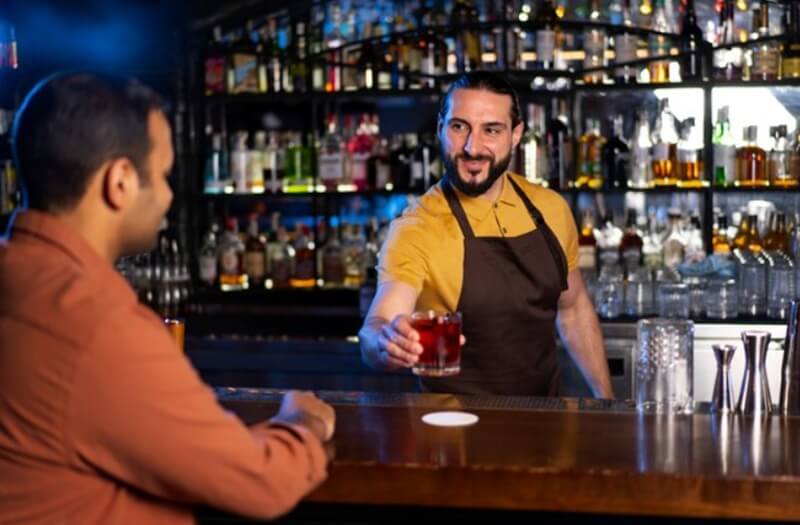
It’s toasty at the bar. It’s warm enough to relax a jacket and lower a guard without being uncomfortable. Three chairs down someone is laughing too loudly. The amber lighting above the counter is mild enough to soften every face in the space compared to how they would seem in a supermarket aisle with fluorescent lights. Your attention is drawn to the bartender and before your conscious mind has finished speaking your hand is making a tiny motion. One more round. It wasn’t what you had anticipated.
More often than most people would want to acknowledge this occurs. The disturbing reality is that you were never truly in control of the choice in any significant neurological sense. Somewhere faster deeper and without consulting the part of you that sets an early alarm for tomorrow morning it had already been made.
| Category | Details |
|---|---|
| Topic Focus | Subconscious consumer behavior and psychological triggers in social drinking environments |
| Key Science | Neuroscience of the amygdala, limbic system, and subconscious decision-making |
| Primary Research Field | Consumer psychology, behavioral neuroscience, subconscious marketing |
| Key Referenced Concept | System 1 (subconscious) vs. System 2 (conscious) thinking |
| Relevant Statistic | The subconscious drives approximately 95% of purchasing decisions (CMO) |
| Brain Structure Involved | Amygdala, hippocampus, prefrontal cortex, Broca’s area |
| Industry Connection | Hospitality industry, bar and restaurant design, beverage marketing |
| Cultural Context | Social drinking norms, peer behavior, environmental design influence |
For years neuroscientists have documented how the vast majority of human behavior is controlled by the subconscious mind. Roughly 95% of our decisions are thought to be motivated by factors other than conscious awareness. That figure most likely rises at the bar. A near perfect storm for subconscious influence is created when alcohol social warmth precisely calibrated sensory cues and ambient design come together. Once you grasp the basics it’s difficult to ignore how accurately the contemporary hospitality sector has mapped the human brain’s topography.
Similar to a smoke alarm the amygdala is a tiny almond shaped cluster located deep within the limbic system. It quickly determines whether something is a threat or a reward in around seven milliseconds by scanning incoming environmental data such as light levels sounds the presence of familiar faces and the scent of something warm. long before conscious thought occurs. The reward circuitry activates when the amygdala perceives safety pleasure and a sense of belonging rather than danger. And there’s a pull with it. a desire. An impulse that is nearly identical to a free decision.
Whether consciously or unconsciously bar owners and hospitality designers comprehend this in ways that would cause a neuroscientist to nod slowly in recognition. Cortisol is lowered by amber lighting. Lying is encouraged by rounded furniture configurations. A specific tempo of upbeat music boosts alcohol consumption by a quantifiable amount; this is not because it makes people want to drink more specifically but rather because it gradually speeds up people’s movements conversations and glass reaching. The round is ordered because the surroundings made it seem obvious natural and nearly unavoidable rather than because a logical calculation was conducted. The vote has already been cast by the subconscious.
This has a deeper level. In social situations social proof one of the most potent subconscious triggers identified in consumer psychology functions discreetly and nearly instinctively. Something in your brain recognizes a command from the person next to you. It is flagged against previous associations by the hippocampus which is involved in memory and context. Belonging is symbolized by shared rounds. Declining is a sign of detachment. Before the conscious mind has even completed reading the cocktail menu the subconscious mind molded by thousands of years of social survival instinct considers those implications. In this context saying no is perceived by the brain as a slight threat rather than a kind of constraint. The hand then moves once more.
The most truthful thing to say in this situation might be that most people greatly underestimate how little of their actions are self directed during these times. Another factor is the self concept. People behave in ways that are compatible with their self perception according to research on subconscious purchasing behavior. The thought of leaving early will cause psychological friction for someone who identifies as a person who goes out and has a good time not because of societal pressure per such but rather because of an internal narrative that characterizes quitting as being at odds with identity. The subconscious is always checking to see if this behavior aligns with the narrative I provide about myself.
Under social and emotional stimuli the part of the brain responsible for language and speech known as Broca’s area tends to calm down. That’s why at some point in the evening the well reasoned justification you may have for quitting appears to evaporate before it takes shape. The older stronger signals from the back brain overwhelm the thinking and reasoning cortex in the front brain. Emotional and physiological responses happen long before any cognitive decision is registered according to marketing specialists who examine this phenomenon in retail settings. The emotional temperature is higher at the bar. The triggers go off more quickly.
The intentional use of color psychology by businesses also has a subtle impact on drinking establishments. Rich ambers and warm reds which are frequently used in bar decor are thought to increase hunger and generate a sense of urgency. For many years fast food restaurants and lodging facilities have recognized this. Amber calms red excites and when combined they create a delightful suspension in which time seems to pass differently and the argument for leaving becomes more ethereal.
The most potent trigger of all is probably the social mirror. Individuals control their conduct by observing others and the subconscious gravitates toward the mean in a crowded space. The subconscious recalculates normal if the majority of those in your immediate vicinity are drinking. The brain which has traditionally valued belonging above reason modifies behavior when sobriety begins to register as deviation at least subconsciously. Even if people were aware of this procedure at the time it’s still unclear if they could effectively oppose it. Being aware of a trigger is not the same as being immune to it.
The architecture of how the manipulation operates rather than the manipulation itself is what makes all of this so fascinating. The subconscious is not feeble. It has no place in an artisan cocktail bar in 2024; it is ancient and incredibly quick sculpted by millions of years of survival logic. This mismatch is remarkably efficiently exploited by the environment. It’s worth taking a moment longer than normal the next time the bartender tilts their chin toward your drink. Just to observe not to moralize. simply to see what goes on behind the surface where the majority of genuine decisions are made.
i) https://www.quirks.com/articles/understanding-subconscious-consumer-triggers-6-terms-you-need-to-know
ii) https://www.blog.hellostepchange.com/blog/subconscious-marketing
iii) https://www.carolynspring.com/blog/managing-triggers/
iv) https://www.theoverwhelmedbrain.com/triggers/