
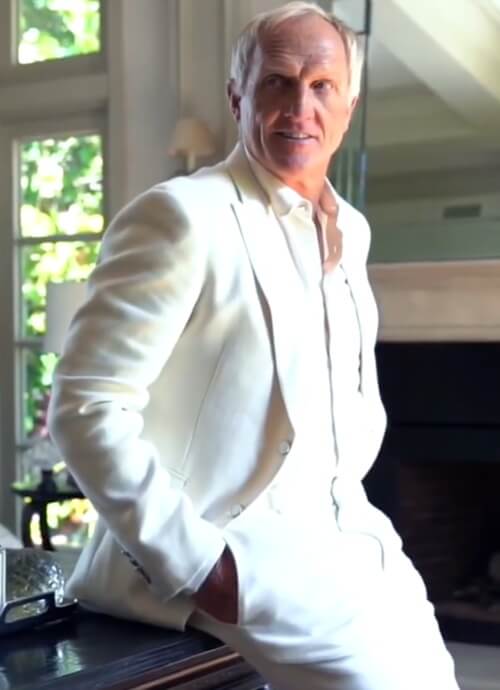
The idea that Jack Nicklaus, who has won more major championships than any other professional golfer, received less than $10 million in prize money during his playing career is almost ridiculous. Today, that amount$9,108,642, to be exactwouldn’t even rank in the top fifty on a single PGA Tour season money list. Despite having declared lifetime earnings of about $1.15 billion, Nicklaus is thought to be worth $400 million. It has very little to do with sinking putts on Sunday afternoons, yet the difference between those numbers reveals everything about how the Golden Bear truly accumulated his wealth.
At the age of 10, Nicklaus father Charlie, a former Ohio State football player, introduced him to golf. Nicklaus was raised in Upper Arlington, a posh neighborhood of Columbus, Ohio. The child was obviously gifted, but he wasn’t one of those prodigies who knew from infancy that sports would be his career. He studied prepharmacy at Ohio State, worked behind a pharmacy counter as a youngster, and only became a professional at age 21 in order to provide for his young family. That particular detail has an anchoring quality. The best golfer in history came dangerously close to becoming a chemist.
| Category | Details |
|---|---|
| Full Name | Jack William Nicklaus |
| Nickname | The Golden Bear |
| Date of Birth | January 21, 1940 |
| Birthplace | Columbus, Ohio (raised in Upper Arlington) |
| Nationality | American |
| Spouse | Barbara Bash Nicklaus (married 1960) |
| Children | 5 (Jack II, Steven, Nancy, Gary, Michael) |
| Education | Ohio State University |
| Professional Career | 1961–2005 |
| PGA Tour Wins | 73 |
| Major Championships | 18 (all-time record) |
| Total Professional Wins | 115 |
| Career Earnings (Lifetime) | ~$1.15 billion |
| Estimated Net Worth | $400 million |
| Primary Business | Nicklaus Design (golf course design) |
| Philanthropy | Nicklaus Children’s Health Care Foundation |
| Reference | Celebrity Net Worth |
Perhaps much of what followed might be explained by this particular practicality, the sense of a man who constantly kept one eye on financial reality. Naturally, dominance on a magnitude that golf had never seen before and may not have seen since followed. Six Masters wins, five PGA Championships, four U.S. Opens, and three Open Championships were among the eighteen major titles that Nicklaus won in 73 PGA Tour events.
In addition, he placed second in majors nineteen times, an astounding total in and of itself. The 1986 Masters, which he won at the age of 46, is still regarded as one of the most memorable and intense events in the history of the sport. You can still sense the incredulity in the commentary when you watch footage of that last round; everyone at Augusta understood that this wasn’t supposed to happen, possibly even Nicklaus.
However, the winnings from all of that? Even by the standards of his time, it was nearly modest. He made roughly $5.7 million on the PGA Tour and an additional $3.4 million on the Champions Tour. To put things in perspective, the winner of a single major now earns more than $3 million. Even though Nicklaus won 18 of them, his total career earnings were less than what a contemporary winner makes in a single weekend. What Nicklaus did off the course is all the more intriguing because the economics of professional golf have altered beyond recognition.
Nicklaus Design, the golf course architecture company he started more than 50 years ago, is the true motor of the Nicklaus fortune. In more than 45 nations and 40 states in the United States, the firm has created over 425 courses. That is an empire, not a side gig. Everyone who has played a Nicklausdesigned course, from resort layouts in the Caribbean to Muirfield Village in Dublin, Ohio, understands the style it is tough, strategic, and created for tournament golf, but it is also playable for amateurs who are willing to select the appropriate tees.
It’s possible that no one person has had a greater physical influence on the golf scene worldwide. In 2016, Forbes listed Nicklaus as the fourth highestpaid athlete of all time, citing his lifetime earnings of $1.15 billion and noting the design firm as his main source of wealth. Only Tiger Woods, Michael Jordan, and Nicklaus’s fiercest opponent, Arnold Palmer, were placed higher.
There were other business plays than course design. Through Nicklaus Companies, Nicklaus expanded his business operations to include lifestyle branding, real estate development, and licensing agreements. He has partnered with Perry Ellis, Rolex, Terlato Wines, and the Arizona Beverage Company, where he followed Palmer’s lead with a branded lemonade, using his name and the Golden Bear brand.
Golf balls, instructional books his 1974 handbook Golf My Way is still regarded as a classic, and computer games carrying his name are also available. Together, they depict a person who realized that a legendary name has commercial value long after the last trophy is raised, even though none of these alone define an empire.
This narrative also has a philanthropic aspect that merits consideration, in part because it is truly extensive and in part because it sheds light on the man’s goals. The Nicklaus Children’s Health Care Foundation was established in 2004 by Nicklaus and his wife Barbara. Since then, the organization has raised over $195 million for pediatric healthcare.
The primary hospital and its satellite facilities were renamed the Nicklaus Children’s Hospital in 2015 as a consequence of the couple’s $60 million donation to the Miami Children’s Health System. The magnitude of that commitment is difficult to ignore. Giving hundreds of millions of dollars to charity doesn’t just happen; it takes decades of consistent, purposeful generosity.
Nicklaus became the only nonroyal living person to ever feature on a British currency when Scotland honored him by placing his face on a commemorative fivepound note. A museum honoring his career was constructed at Ohio State. He organizes the Memorial Tournament every year at Muirfield Village, which has grown to be one of the PGA Tour’s marquee events while discreetly supporting philanthropic organizations. There is a cumulative weight to these accolades and establishments. They point to a figure whose impact goes far beyond balance accounts and record books to the actual physical and cultural aspects of the sport.
Among the wealthiest golfers in history, where does Nicklaus stand? Fourth, behind Arnold Palmer $700 million, Greg Norman $400 million, and Tiger Woods estimated at $1 billion. Phil Mickelson is currently worth almost $300 million thanks to his LIV Golf payout. With Saudi backed tours giving guaranteed contracts and the PGA Tour restructuring in response,
it’s still uncertain if the shifting economics of professional golf would eventually cause younger players to surpass Nicklaus on the wealth rankings. However, there’s a feeling that what Nicklaus created is distinct in kind rather than merely degree. He didn’t receive his wealth as a signing bonus. Over the period of more than 50 years, it was systematically built, course after course and deal by deal. It turns out that the son of the pharmacist has always had a keen eye for business. In addition, he was the best golfer in history.
i) https://www.celebritynetworth.com/richest-athletes/richest-golfers/jack-nicklaus-net-worth/
ii) https://www.golfmonthly.com/news/what-is-jack-nicklaus-net-worth
iii) https://www.therichest.com/celebnetworth/athletes/golfers/jack-nicklaus-net-worth/
iv) https://www.deemples.com/blog/jack-nicklaus-net-worth