
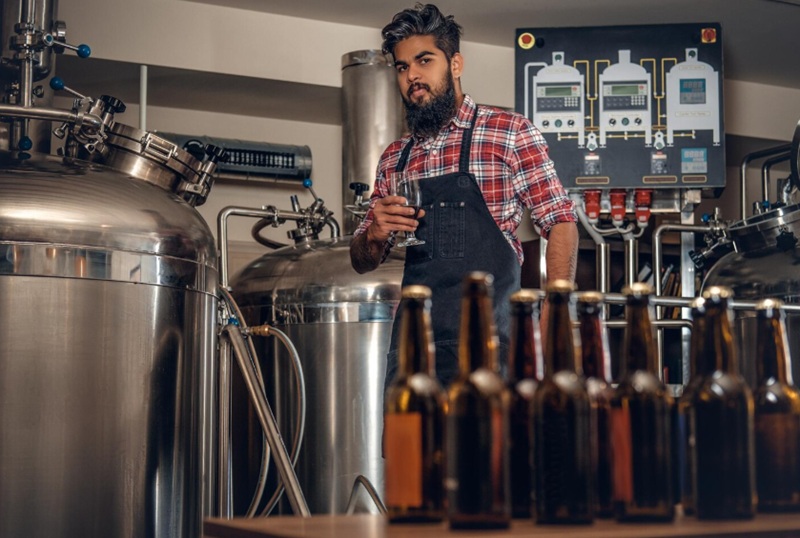
Something changes when you go into the correct bar on a rainy Tuesday in Bristol or Sheffield. This year’s beer list isn’t a laminated sheet of the same four taps found in every chain hotel and airline lounge. A pint from three miles away was produced last week and is named after a half forgotten colliery or a nearby canal. The brewer is known to the barman. This is probably where the brewer drinks. Perhaps it’s a minor detail, but it’s the kind of minor detail that makes a bar feel like somewhere rather than anyplace, and that distinction turns out to be the whole point of contention.
Pubs are closing in Britain at a pace of one every day. Almost three breweries are closing each week. There is no coincidence between those two numbers. They tell the same tale from different ends of the same supply chain, and now more than at any other time in the last century, it is critical to comprehend how closely linked the two are. The term “survival crisis” has been used by the Society of Independent Brewers, and even that framing may understate how near the industry is to a structural rupture that would be difficult to restore.
It is quite unpleasant to sit with the stark realities of the market. Approximately 78% of the beer served in UK pubs is currently produced by five international brewing corporations. At the height of the industry in 2023, there were more than 1,800 independent brewers, accounting for around 6% of the total. The sorting is not based on consumer preference. The legacy of the beer tie, which essentially gives big brewers a gatekeeper role over what publicans can really stock, and supply agreements and dispense equipment contracts are to blame. Before a single order is placed, the infrastructure frequently works against the publican who wants to put a local pale ale on the bar. The rest of the UK is still waiting to see what happens after Scotland granted guest beer rights to tied tenants in 2025.
| Topic | Independent Breweries & British Pub Sector |
| Governing Body | Society of Independent Brewers (SIBA) |
| Founded | 1980 (SIBA); craft beer resurgence peaked ~2023 |
| Peak Brewery Count | Over 1,800 UK breweries (2023) — highest since the 1930s |
| Current Pub Count | Fewer than 40,000 (down from ~60,000 in 2000) |
| Closure Rate (Pubs) | Approximately one per day throughout 2025 |
| Closure Rate (Breweries) | Nearly three per week (2025) |
| Market Share (Global Brewers) | Five companies control ~78% of beer sold in UK pubs |
| Independent Share | ~6% of the pub beer market |
| Jobs Supported | Over one million across the wider sector |
| Economic Contribution | £34.3 billion GVA; £18 billion in annual tax revenue |
| Consumers Misled by Faux-Craft | 75% believe they have been misled (YouGov) |
| Consumers Wanting Local Beer | 80% want independent beers on the bar |
| Key Legislation | Small Producer Relief; Draught Relief; Scottish Pubs Code (2025) |
People seem to be misinformed about what independent breweries truly contribute to a pub’s business case. They do more than simply fill a faucet. A pub that carries a carefully curated selection of locally brewed beers is accomplishing something that the store two blocks away structurally cannot: providing an experience that is unique to this location, tonight, in this room. In a time when consumers are proficient in the language of authenticity and very skeptical of products that merely perform it, it is a potent competitive advantage. According to a YouGov study, 75% of consumers think they were duped when they bought what looked like craft beer from a company that is controlled by a multinational conglomerate. There’s no denying the desire for the actual thing. Whether the market is designed to provide it to them is the question.
Pubs and independent breweries have a significant enough economic impact to merit considerable policy attention, but this has only lately begun to happen. The industry sustains over a million jobs, generates over £34.3 billion in gross value added, and generates £18 billion in tax revenue annually, according to a study released by the All Party Parliamentary Beer Group in late 2025 that outlined a ten point plan for government. According to most industry accounts, the subsequent Autumn Budget was disappointing since beer duty increased rather than decreased and the draught relief that may have reduced the price difference between the pub pint and the supermarket can was not prolonged. Early in 2026, Reform UK proposed a five point plan that included a 10% reduction in beer duty and a 10% reduction in hospitality VAT. The proposal claimed that these changes might eventually result in a pound being removed from every pint. It’s still truly uncertain if any of it becomes policy.
It’s difficult to ignore how much of this discussion revolves around a seemingly straightforward query regarding the true purpose of pubs. The phrase “third place” was first used decades ago by sociologist Ray Oldenburg to describe places where people can congregate equally and without agendas but are neither home nor work. Many community centers, churches, and libraries have shrunk. The bar has endured as arguably the most resilient of all these places in British culture, and scholarly studies on the effects of its disappearance on communities are clear. According to a Loughborough University study, pub closures undermine the unofficial networks that foster friendships, disseminate local news, and provide people who may otherwise feel alone a sense of community. After witnessing a once loved pub fall into disrepair, a resident of a former colliery village in Nottinghamshire stated that she now believed it would be preferable to demolish it in order to end our suffering. There’s more to that sentence than meets the eye.
The same community mentality permeates the breweries that supply those bars. Local charity are supported by 82% of independent breweries. Community is crucial to their identity, according to 96% of respondents. The brewer at the farmers’ market, the taproom doing a fundraiser, and the delivery van that is also, covertly, a part of the local supply chain are examples of how small brewing enterprises actually operate rather than just marketing claims. The impact of a brewery closing extends beyond the balance sheet of the business. A supplier loses a client. A product that regulars requested is lost. The town loses something that is difficult to describe but simple to sense.
The micropub movement has demonstrated that there are still viable models, traditional spaces centered on discussion and cask ale that prosper by maintaining minimal fixed expenses and a high human aspect. A bar may thrive and benefit its community when it is operated for local gain rather than distant shareholder value, as community ownership has shown. The number of community owned pubs has increased from 14 in 2010 to over 150 by 2022, according to the Plunkett Foundation, with communities continuously reporting benefits that go beyond the bar itself. These are stories that serve as proof of concept. Even while they are unable to scale quickly enough to close the deficit on their own, they are encouraging.
The course is not predetermined. It won’t go back. The connection between the independent pub and the local brewery isn’t a throwback to British drinking culture. It’s a functional social and economic structure that continues to function where permitted and is under enough structural strain to silently vanish before most people notice. This is what makes the topic of whether local brewers are still important to the survival of independent pubs so worthwhile, more so than any one closure or budgetary choice. Clearly, the answer is yes. The question that still has to be answered is whether or not enough people take prompt action.
i) https://atticbrewco.com/blogs/news/why-indie-beer-matters-a-lot-more-than-you-think
ii) https://wb.camra.org.uk/2026/04/15/independents-capitalise-on-keeping-it-local
iii) https://www.andysbeerreviews.com/2026/05/why-are-so-many-uk-breweries-struggling.html
iv) https://amp.theguardian.com/business/2021/may/15/small-breweries-work-flat-out-for-the-uks-grand-pub-reopening