
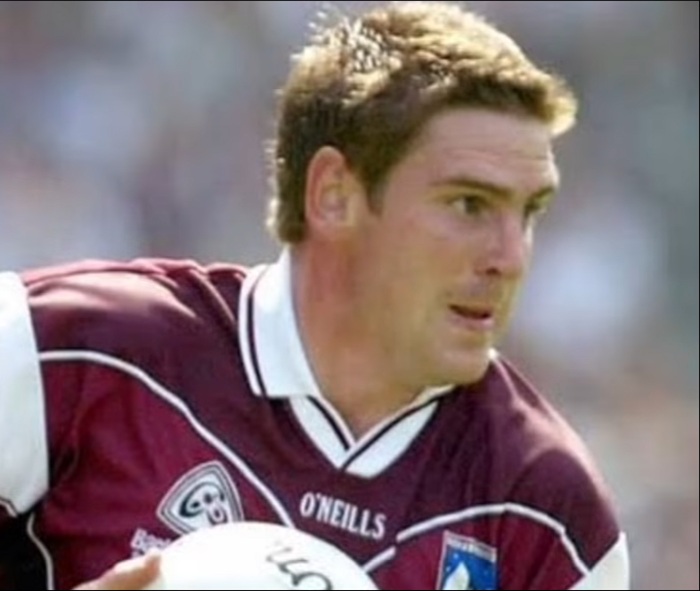
The news came on a Tuesday morning, in a short Galway GAA post that landed heavier than its word count suggested. Paul Clancy, a two-time All-Ireland winner and Moycullen’s most decorated son, has passed away at the age of forty-nine following a battle with cancer. In villages across the west of Ireland, where the local pitch still sets the rhythm of a week, the reaction was less shock than a collective wince. He was known to be ill. Few had understood how serious it had become.
What made his illness so remarkable in the days that followed was how little he let it define him. His wife, Johanna, gave the nearest thing to a public description of his latter years at his Funeral Mass in Moycullen and it was not a story of deterioration.”.She didn’t want Paul to be sick. He didn’t think he was ill.
All he saw was resilience, resolve and recovery ahead of him, taking each stage of treatment methodically, the way he once launched that injury-time winner against Armagh in 2001, or floated the no-look pass over his shoulder to Declan Meehan against Kerry in 2000. There was a feeling that the framing mattered enormously to him. He was never the star, Johanna mused, but always the hero laboring behind the scenes.
Her eulogy gave a rare glimpse into the machinery of his care, thanking the teams at Galway University Hospital, Beaumont Hospital in Dublin and Cancer Care West, and insisted no stone had been left unturned. Those three names hint at the shape of the fight without describing it: local acute care close to home, specialist intervention in the capital and the practical, emotional support that a western cancer charity quietly gives to families the public never hears about. Behind every famous name that falls ill there is this hidden architecture of wards and waiting rooms, and Johanna, in the middle of her own grief, chose to honour it.
Of course, his body had tested him before. The knee injury he suffered in June 2006 was described at the time as career-threatening, the scan results grim enough to cast doubt on his future in the game. And he returned. Late in 2012 he suffered a stress fracture to his leg, during his club years, which kept him out of the game for two months. And he came again. Over two decades, watching the pattern repeat, it’s hard not to see the same instinct at work in his final illness, the stubborn, unglamorous business of recovering and returning, applied one last time to a fight that could not be won.
And yet there were victories, of a sort. His health had become more stable by February 2026, when the family moved into their new home, a project his friends had rallied to finish once he fell ill, a gesture Johanna called heroic. There was a rugby trip to France for his son Finn, a confirmation for his daughter Ellen, a weekend in Roundstone and Clifden, a golf night away with friends. Extraordinary weight, common pleasures, wrested back from the illness. These were the dividends of the treatment she later honoured, and of a resolve that never quite faltered.
The county responded in the language it knows best. Ahead of Galway’s All-Ireland quarter-final against Dublin, manager Pádraic Joyce, a teammate from the 1998 and 2001 triumphs, confirmed the number ten jersey Clancy had made his own would not be worn, with Cein D’Arcy switching to twenty-two instead. GAA President Jarlath Burns sat among the mourners in the packed Moycullen church, where the coffin arrived draped in Galway and Maigh Cuilinn colours as Christie Hennessy’s Remember Me played. A fishing rod, a golf club and a family photograph were carried forward, small windows into the man beyond the medals.
Whether Galway football will see his like again is anyone’s guess. What seems certain is that his illness, faced with the strength, stoicism and stubbornness his wife described, has become part of his legend rather than a footnote to it. His friend Pat Comer put it simply: PC, where the C stood for Cool, unassuming but cute as a fox, lost within earshot of the evening Angelus. A county will miss him. A village already does.