
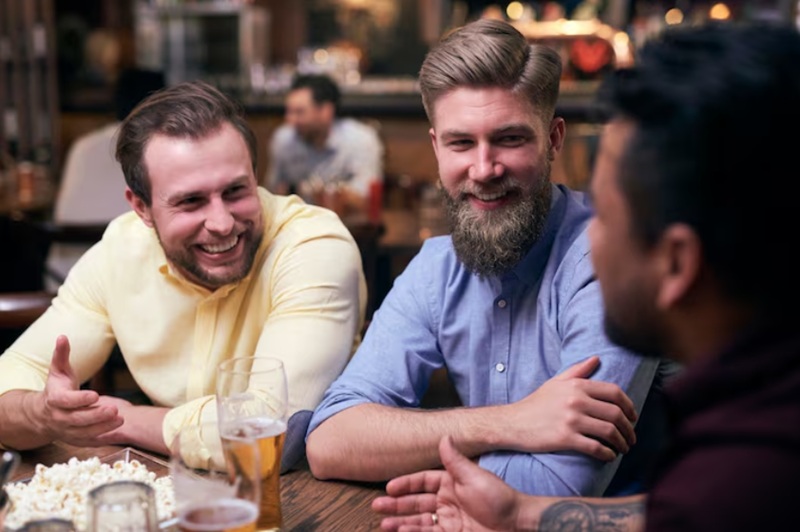
In a village in Shropshire, there is a pub with no chain branding and no Instagram optimized menu. It opens at noon, and the same four patrons typically arrive by half past. It has been eighteen months since one of them lost his wife. He is thirsty, so he doesn’t enter. He enters because the alternative is to spend another afternoon by himself in a house that has been uncomfortable since she passed away. This is known to the landlady. It doesn’t happen because of her. After asking about the dog and pouring his half, she lets him sit. A third place does just that in silence. It is not a form of welfare. It is merely a space where people can live without needing to give an explanation.
For many years, urban planners have debated the idea of a “third place” somewhere that is neither home nor work, where people can arrive without a plan and remain without ceremony. Cafes, barbershops, and taverns were the main examples used by sociologist Ray Oldenburg in his 1989 article. That list has always included pubs in Britain. Data on pub closures and a somewhat desperate national dialogue about loneliness are supporting the growing perception that the question is now urgent. In a significant and long lasting way, are local pubs turning into true third places in Britain once more? Or is this primarily a sentiment disguised as a fad?
| Category | Details |
|---|---|
| Subject | The British pub as a third place and community social infrastructure |
| Classification | Hospitality venue / civic social space |
| Sector | UK licensed trade, community welfare, social policy |
| Peak UK pub count | 70,000+ (early 20th century) |
| Current UK pub estimate | Approx. 46,000–48,000 (2024–25) |
| Key trend | Community ownership, multi-use pub models, alcohol free options |
| Relevant legislation | Localism Act 2011 (Assets of Community Value designation) |
| Key organisations | British Beer & Pub Association, CAMRA, Plunkett Foundation |
Pubs in Britain have been disappearing for decades. The 2008 financial crisis, the 2020 lockdowns, and the more recent cost crunch that has squeezed everything from energy bills to beer duty have all contributed to the thousands of closures that have occurred since the year 2000. The figures are well documented and truly depressing. It is more difficult to measure what a pub takes with it when it closes. The street loses something that had no official name on any council register when the planning application is approved, the sign is taken down, and the Victorian tiled interior is demolished for apartments. It was merely a place where people went. The majority of local governments may still lack a practical way to quantify that loss, which contributes to its persistence.
The language people use to defend pubs that are under threat has changed recently, and this does seem like a real shift. A generation ago, local jobs, heritage, or the inconvenience of having nowhere to drink could have all played a role in a campaign to close pubs. The arguments now often end differently. Usually, community organizations that are using shares and fundraising to save their local pub are not doing so because they want a cheap pint.
They act in this way because they recognize often intuitively that the bar serves as social infrastructure. It matters, the room itself. A location where people of all ages, socioeconomic backgrounds, and temperaments can coexist in the same area without organizing anything that is actually uncommon in contemporary British life, and people appear to be noticing its scarcity.
The revival of the “third place” in pubs is not consistent, nor is it nostalgic in the traditional sense. To be honest, the old local was not always inclusive. In the past, a lot of pubs had very specific rules about who was allowed in, and some of those rules still exist. The bars that appear to be prospering both financially and socially are frequently those that have expanded their definition of what constitutes a pub. Before noon in the morning, coffee.
A lunch for retirees who wouldn’t otherwise go outside. A Tuesday test that attracts teams from all over a postcode. Twenty years ago, it would have been impossible for parents in pushchairs to enter many pubs without feeling uncomfortable. This isn’t a gimmick. They are the bar realizing that its true offering was never the beer, but rather the justification for being together.
Food has made this discussion more difficult. The gastropub model’s detractors have a valid point: a pub can no longer serve as a third place if all of the tables are reserved three weeks in advance and nobody can stop by for a quiet half hour. It is now a restaurant with a different type of license. The tension is genuine.
Food margins can help a pub pay its expenses, but something crucial is lost the moment the bar becomes merely a place for diners to wait. The best pubs do this by maintaining a truly free space, a bar where you can stand or sit without making a reservation, and where regulars and casual patrons can coexist with anyone who has a table. Not all operators are able to achieve that balance, and it is more difficult than it may seem.
Bar employees carry more of this than they are ever given credit for. A landlord who has owned the same pub for fifteen years has knowledge of the neighborhood that no algorithm could match, such as who is having difficulties, who hasn’t been in recently, and who needs someone to discreetly make sure they get home safely.
This unstructured, unofficial welfare position is located within a commercial enterprise and is not officially recognized or compensated. It’s difficult to ignore the extent to which persons whose main responsibilities are managing a cellar and pulling pints perform social functions. Eventually, legislation will need to take seriously the discrepancy between what pubs are expected to do and what they are able to do.
An unexpected variable has emerged from the return to office argument. Because of hybrid working, more people spend their weekdays in residential neighborhoods rather than commuting to or from the city center. This has created daytime business opportunities for certain local bars that were previously nonexistent.
A once dead noon is now sporadically alive. There are clients in the middle of the week. It’s yet unclear if this is a long term structural change or if businesses’ stricter return policies will cause the habit to disappear. It has given some local pubs a foot traffic pattern that resembles a café rather than a conventional evening only business. That is not detrimental. The opening hours of third places are not set.
Being truthful about the motivations behind it will determine whether or not this culminates in a true renaissance. Because the market has suddenly rewarded community value, pubs are not becoming community anchors.
Publicans have adjusted, communities have stepped in, and in the most extreme situations, enough people have witnessed their village lose its final social space to comprehend what was truly there. It’s not insignificant. A tavern that has endured because its patrons have struggled to keep it open is not the same as a pub that has always been. It recognizes its purpose. It frequently behaves as such.
The landlady from Shropshire is unlikely to characterize herself as a third place finisher. She would think the phrase was a little strange. On a Tuesday afternoon, she knows who needs a half hour talk, and that’s what she does. The challenge that the renaissance cannot resolve on its own is whether Britain provides more financial, political, and practical space for that.
i) https://www.morningadvertiser.co.uk/Article/2025/10/31/pubs-remain-vital-social-hubs-amid-closures-and-rising-costs/
ii) https://moneyweek.com/economy/uk-economy/last-orders-can-uk-pubs-be-saved
iii) https://society.sciencearray.com/vanishing-third-places-community-hubs-loneliness-crisis
iv) https://laurenleek.substack.com/p/britain-lost-14000-third-places-they