
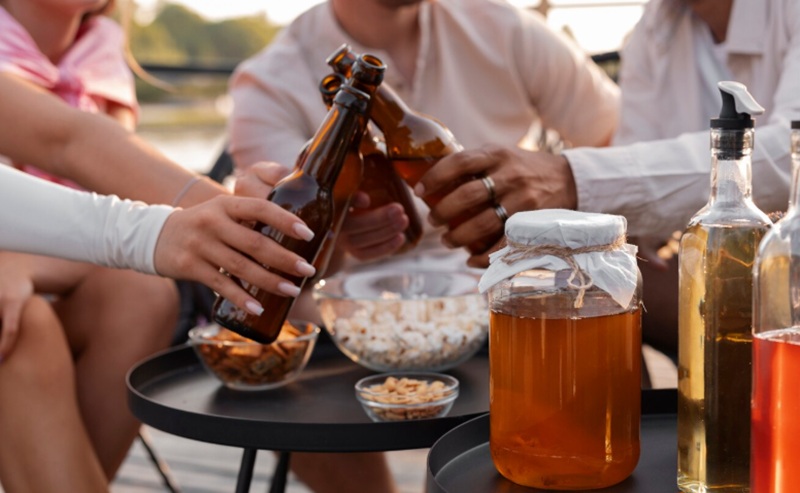
Something has subtly changed as you stand by the Thames on a warm Saturday afternoon. There is still the pint glass. The river light, the wooden terrace, and the soft murmur of conversation remained the same. A significant amount of the food being lifted and consumed at these riverbank tables is increasingly devoid of alcohol. There is no commotion over it. In a sense, that is the whole point.
Since 2013, the volume of the no and low alcohol beer market in the UK has increased by almost 750%. An estimated 200 million pints of these products will be consumed annually by 2025; additional compound increase is predicted until the early 2030s. These are not a niche curiosity’s numbers. They imply that something more enduring is taking place, something that has been gradually developing in the background of British pub culture while the majority of the discourse stayed on other topics.
| Category | Details |
|---|---|
| Trend Name | The Quiet Rise of Alcohol-Free Beer in Waterfront Pubs |
| Market Size (2025) | 200 million pints of no/low alcohol beer consumed in the UK |
| Growth Since 2013 | 750% volume increase in the no/low alcohol beer category |
| Pub Availability | 87% of UK pubs now stock at least one alcohol free option (up from 2% in 2019) |
| Draught Availability | 25% of managed pubs serve alcohol free beer on draught |
| Consumer Reach | 45% of UK adults consumed low/no alcohol drinks in the past 12 months (2025) |
| Top Brands | Guinness 0.0, Heineken 0.0, Lucky Saint, Nirvana Brewery, Jump Ship Brewing |
| Key Waterfront Hubs | Thames (London), Bristol Harbourside, Manchester canals, Weymouth seafront |
| Regulatory Body | British Beer and Pub Association, the Portman Group |
For this shift, waterfront bars have emerged as an improbable but appropriate venue. It has a certain logic to it. Walkers, bikers, boaters, families, post run groups, and afternoon visitors who might have hours of towpath ahead of them are drawn to riverside and coastal taverns. It’s not always a good idea to pair alcohol with an afternoon stroll along the Thames Path. For the first time in a long time, the drinks cabinet is catching up with the waterfront tavern, which has always given its patrons reasons to be alert.
Quality has been the most obvious force behind this change. For many years, if you ordered an alcohol free beer at a bar, you had to settle for something thin, slightly metallic, and regretful. A large portion of the original drink’s enjoyment was lost due to the procedures, which usually required using heat to boil out the alcohol. That issue has been basically resolved. Thanks to developments in vacuum distillation, reverse osmosis, and cryogenic fermentation, brewers can now either gently remove alcohol or stop it from forming in the first place while maintaining the essential flavor constituents. Now, a well made alcohol free stout has a stout flavor. Launched in 2021, Guinness 0.0 is currently valued at around £50 million and makes up almost one fifth of all Guinness off trade sales by value. By value, Heineken 0.0 controls 38% of the on trade low alcohol beer market. Placing these goods in a different category during blind tasting is actually quite challenging.
Without a corresponding cultural shift, the quality increase might not have been enough on its own. Pub patrons in Britain seem to have truly renegotiated their relationship with alcohol, not given up on it, but relaxed its hold on social norms. Approximately 76% of persons in the UK say they have moderated their consumption in some way. Nowadays, one in three bar visits are completely alcohol free. Zebra striping, which involves switching between alcoholic and non alcoholic beverages within a single session, has becoming more commonplace. The largest pub company in the UK, Stonegate Group, sold 271,000 alcohol free drinks in the first quarter of 2025 alone, a 32 percent increase over the previous year.
The decision has become so ordinary that it is particularly noticeable in seaside venues. It is difficult to discern any social tension surrounding the alcohol free pint when observing this on a busy summer afternoon at a pub by the harbor. No one is providing an explanation. The glass appears identical. It is still a rite. For a very long time, social visibility the ability to stand out in a crowd and look different was just as important a barrier as taste. Quietly, that barrier is vanishing.
Compared to the conventional narrative about sober Gen Z consumers, the demographics reveal a more nuanced picture. Approximately 61% of consumers of beer with no or low alcohol content are millennials, who are currently in their late twenties to early forties. According to Stonegate’s data, the largest users in their estate were not youngsters but rather those aged 25 to 34. These individuals are adjusting their relationship with alcohol in order to balance their employment, motherhood, fitness objectives, and the strain of rising living expenses. It has begun to make sense to spend £4.50 on a pint of something calorie efficient, clear headed, and free of anxiety the next morning.
At the pub level, there is still a certain amount of uncertainty. Because the higher production costs outweigh the processing savings from avoiding duty, alcohol free beer frequently wholesales at rates that are comparable to those of full strength versions. Pint margins are minimal. Industry operators are beginning to realize that the true value is found in the incremental customer the designated driver who now stays for three rounds instead of nursing a lime soda, or the Saturday afternoon walker who pulls in from the Thames Path and orders something she truly wants rather than in the margin per unit.
Beyond its practicality or picturesque setting, the waterfront bar has a special position in British culture. The Crabtree in Fulham, the Prospect of Whitby, and the Anchor Bankside are more than just bars. Their social memory spans centuries. It’s also important to remember that the alcohol free movement that is spreading among them does not contradict what they stand for. If anything, it’s an extension. We welcome more folks. More events were served. The same light, the same tables, the same water, and now a drink that doesn’t require anything from you the following morning. There is still a silent boom going on.
i) https://impossibrew.co.uk/blogs/journal/how-drinking-habits-shape-non-alcoholic-beer-trends
ii) https://www.drinkedition.co.uk/post/the-rise-of-no-low-alcohol-in-uk-pubs-still-a-fad-or-here-to-stay
iii) https://nirvanabrewery.com/blogs/news/the-growth-of-alcohol-free-beer
iv) https://inews.co.uk/inews-lifestyle/new-alcohol-free-pub-uk-sobriety-2569330