
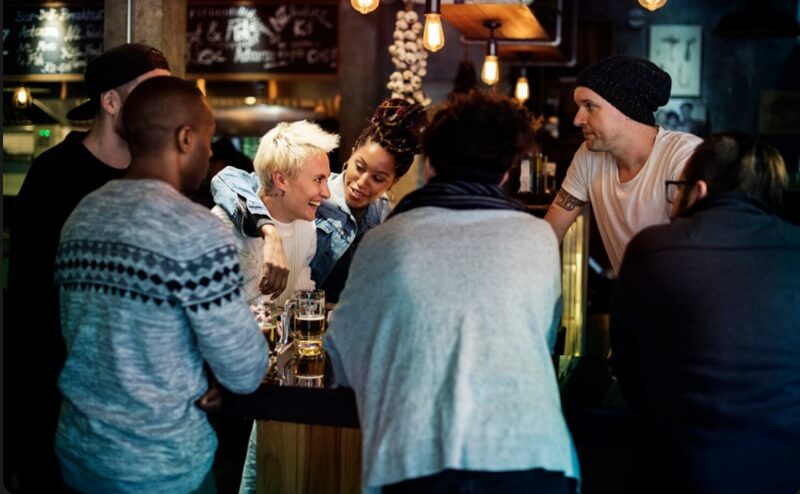
See what happens when you walk into any pub on a Friday night. Not at the taps or the bar but at the tables. Observe how a group of four people settle in with their coats barely off and in a matter of minutes someone is standing up and asking what everyone wants. That group has most likely spent more by the end of the evening than any one of them had anticipated. It is not a coincidence. Group dynamics is at play here and it’s one of the most subtly potent factors in the British pub economy.
When you actually look at the numbers they are startling. Pubs continue to capture 29% of all hospitality consumer spending in the UK more than fast food casual dining and delivery services put together according to data from KAM and the British Institute of Innkeeping. That’s a sizable portion and it’s not just because people enjoy beer. It occurs at least partially because individuals enjoy socializing. Additionally going out with others alters your spending habits.
| Category | Details |
|---|---|
| Organisation | KAM (Insight Consultancy) & BII (British Institute of Innkeeping) |
| Report | The Pub Roadmap — Consumer Spending & Behaviour in UK Pubs |
| Key Finding | Pubs command 29% of total UK hospitality consumer spend |
| Top Spending Age Group | 18–34-year-olds (28% share of pub spend) |
| Drink-Only Visits | 36% of pub visits (up from 26% in 2022) |
| Average Dwell Time | Slightly down vs 2022, net decrease of 4% |
| Price Acceptance | 51% of customers found pub price increases acceptable in 2023 |
| Premium Experience Gap | Significant disconnect between customer desire and publican delivery |
| Relevant Industry Player | Stonegate Group — largest UK pub company (~4,500 venues) |
| Reference | https://kaminsight.com/insights/pub-roadmap/ |
The most evident example is certainly the round system. Most people don’t stop to consider it because it’s such a common aspect of British pub culture but from an economic standpoint it’s very intriguing. The mental accounting changes when you are purchasing for five others rather than just yourself.
For a brief moment spending £30 at the bar seems more like a social gesture than a financial choice because the cost of each drink is abstracted and distributed throughout the group. One of the reasons group pub visits consistently result in higher average spend per head than solo visits may be due to this social framing which holds that purchasing rounds is generosity rather than expenditure.
Additionally there are what behavioral economists refer to as social ordering effects. When one person at a table places a food order the others usually follow. Upgrading to a craft pint or a premium cocktail subtly changes the benchmark for what other people order.
According to KAM’s research there is a big disconnect between what patrons of pubs genuinely desire in terms of upscale experiences and how aggressively publicans are pushing their employees to upsell. Every week that disparity costs publicans actual money and group dynamics are exactly the setting in which a well timed recommendation can result in an upgrade for the entire table.
Contrary to popular belief furniture and surroundings have a direct impact on this. Table design actually affects how people communicate according to research on seating in beer gardens. For example round tables promote dialogue and collaborative decision making.
Ordering decisions become collective rather than individual when the physical arrangement brings individuals together. When one person decides to stay for another drink the entire party can follow suit. In the hospitality industry the relationship between dwell time and spend is well established; patrons who remain longer tend to spend more frequently placing unplanned orders. Stable comfortable seating keeps groups seated for longer.
Another element is added by the demographic picture. The age group of 18 to 34 continues to spend the most money at bars and visit them more frequently than any other age group. This generation has grown up in a social media world when the experience of a venue how it looks feels and whether it’s worth sharing matters almost as much as what’s in the glass.
They also socialize in larger groups and are more impacted by peer decisions in real time. A group of six people in their mid twenties are curating an experience rather than merely spending money. Spending naturally rises as a result of this collective investment in the evening.
It is difficult to ignore how this dynamic can also produce a sort of subdued pressure. In a gathering not everyone desires another drink. Keeping up with a round that intensifies over three hours is not something that everyone can afford. The need to keep up financially and the social glue that makes group pub outings attractive are at odds.
According to some study part of the reason competitive socializing venues like escape rooms darts bars and crazy golf are becoming more and more popular is that they provide group activities where participation isn’t dependent on alcohol consumption. Alcohol focused bars can’t always fit the activity’s framework.
Dynamic pricing complicates group behavior in its own unique way. There was a quick and intense criticism when Stonegate Group imposed 20p peak time surcharges across its approximately 4 500 venues including chains including Yates and Slug & Lettuce. Calls for boycotts swiftly flooded social media.
That response showed more than simply irritation over a somewhat higher pint price. It became clear how sensitive individuals are to the idea that social gatherings are being exploited. People who have selected a pub for a birthday party or a get together for drinks at work don’t want to feel like demand targets. The reference point issue is real: if a party typically pays £5 per pint a peak surcharge feels more like a punishment for going out together than an economic adjustment.
Nevertheless there is still a great need for high end pub experiences. According to KAM’s research 82% of patrons at bars choose a smaller serving of higher quality food over a larger serving of lower quality food. 70% of respondents want to be able to personalize their food orders.
These are the tastes of people who want to have fun and are willing to pay for it when the offer feels appropriate not those who are hesitant consumers. This is amplified in a group situation. A entire table can be brought along by one person who is passionate about a menu. The entire evening’s spend can be increased by one really informed bartender discussing craft beer with an inquisitive group.
How the hospitality industry will strike a balance between these insights and the persistent cost pressures rising labor energy prices and the remaining pinch of inflation while avoiding pushing group pricing to the point where the social calculation fails is still up for debate. Pubs endure because people want to hang out there. The dynamic changes in ways that are very hard to undo when spending time in those groups begins to feel more like a duty than a pleasure.
i) https://www.theaccessgroup.com/en-gb/blog/hos-dynamic-pricing-in-restaurant-and-pub/
ii) https://www.trustpayments.com/blog/how-pubs-and-restaurants-can-adapt-to-change-in-a-shifting-market/
iii) https://www.smetoday.co.uk/features/why-more-people-are-choosing-competitive-socialising-over-going-to-the-pub/