
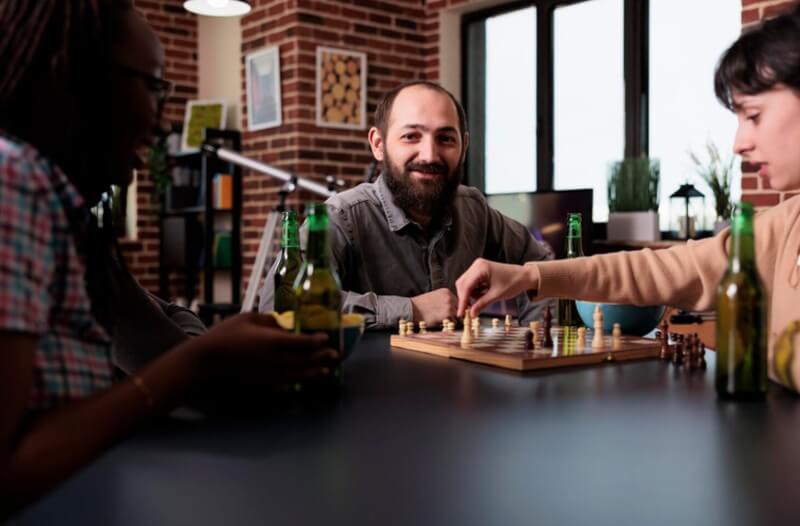
The tavern seems quieter than it should be on a soggy Thursday night in East London. No packed dance floor, no pounding bass. Rather, four individuals are leaning over a scratched wooden table by the window, silently debating whether a bishop can actually trap a knight. Half finished pints are positioned between a chessboard. Nobody appears to be in a rush. It’s difficult to ignore how commonplace this has begun to feel.
Pubs sought volume for years, adding bigger screens, better lights, and louder music. At some point, the domino boxes vanished into storage, the dartboards were demolished, and dining tables subtly took the place of skittle alleys. However, something has changed recently. Not in a big way. It’s more like a gradual shift in the tide. People seem to be growing weary of dull nights out.
| Category | Details |
|---|---|
| Topic | The Comeback of Traditional Pub Games |
| Industry | Hospitality & Leisure |
| Key Organisation | Campaign for Real Ale (CAMRA) |
| Focus Area | UK Pub Culture & Social Gaming Trends |
| Key Trend | Rise of “Competitive Socialising” |
| Demographic Shift | Strong growth among 18–34-year-olds |
| Notable Data | 38% increase in activity-led venues since 2018 |
| Reference Website | https://www.tradgames.org.uk |
In a sense, the numbers validate the tone. In recent years, the number of activity led venues places centered around games and shared experiences has increased dramatically, by about 40% since 2018. Not only is the growth intriguing, but so is the person behind it. Compared to traditional pubs, younger folks, especially those in their twenties and early thirties, are spending disproportionately more in these venues.
However, statistics only provide a portion of the picture. Small gestures in the corners of bars are where the real change is taking place. A person taking a deck of cards out of a coat pocket. A group shifting tables to accommodate an unplanned board game at the start of the evening. Perhaps this is more about relief than nostalgia.
Many people had to relearn board games during the pandemic years. Too much screen time, few options, and long evenings spent at home. It wasn’t anticipated, at least not by many, that the habit would return to public areas. And yet here we are, silently reclaiming bar tables while watching games that were formerly associated with family living rooms.
The renaissance has taken on nearly experimental shapes in locations like Brighton. Once obscure and hyper local, classic games like toad in the hole are making a startling comeback. Each slightly flawed handmade table attracts small groups of people who applaud when a brass disk lands perfectly. It appears to be a novelty at first. But if you stay, it begins to feel more profound, almost communal.
Pub owners, many of whom have been concerned about dwindling foot traffic over the past ten years, now discuss games not only as entertainment but also as a means of keeping patrons stationary. A drink doesn’t last as long as a dart battle. Risk can be played for hours. Even something as basic as Connect 4 appears to make people pause and want to stay.
However, it’s unclear if this model is more profitable. Half jokingly, several owners acknowledge that players frequently consume less alcohol. They take their time placing orders, linger, and occasionally completely switch to soft drinks. However, they come back. They also bring others.
When you watch a group in the middle of a game, the atmosphere clearly changes. Conversations seem less hurried and more nuanced. Laughter is present, but so is focus the kind that seldom endures in noisier settings. It produces a distinctive beat that is somewhat fuller yet quieter.
Even seasoned operators are surprised by the appeal’s cross demographic reach. What started out as a fad among younger, wealthy guys has swiftly spread. Perhaps drawn by the accessibility, families, women, and elderly customers are taking part. No costly equipment. There is no difficult learning curve. Just a willingness to play and a common set of rules.
Additionally, there is a cultural undertone that is more difficult to measure. Modern life is dominated by screens, which are glowing rectangles that are used for work, communication, and enjoyment. In contrast, games like dominoes or darts require presence. Small tensions are playing out in real time as hands move and eyes connect. It’s not quite a rejection of technology. A counterweight, if you will.
The change is subtle in some bars. A board game shelf next to the bar. A weekly darts league is announced on a chalkboard. In others, it’s more purposeful themed nights, selected collections, and designated areas. Although it frequently feels more natural than the name implies, the idea of competitive socializing has become somewhat of a buzzword in the industry.
How these games integrate into contemporary life may be the most telling feature. It is meant to be an addition rather than a substitute for anything else. A method of organizing time without making too many plans. A backup plan that seems purposeful in some way.
Nevertheless, all of this is unknown. Trends are ephemeral. What is novel today can become the norm tomorrow. Some classic games are still having trouble surviving because they rely on local aficionados or outdated, hard to replace equipment. But the indicators are there, at least for the time being.
The chess match goes on that Thursday night. Another round is ordered by someone. For a while, nobody checks their phones. The city is moving outside as it always does: quickly, preoccupied, and a little impatient. Time seems to go on forever inside. It’s not a revolution. Not even near. However, something is undoubtedly taking place.
i) https://www.morningadvertiser.co.uk/Article/2024/06/07/can-you-still-play-traditional-games-in-pubs/
ii) https://www.seriousaboutevents.co.uk/why-darts-and-skittles-are-making-a-comeback/
iii) https://www.economist.com/britain/2025/12/26/pub-games-have-been-getting-a-lucrative-makeover
iv) https://www.mirror.co.uk/news/uk-news/beer-and-skittles-are-booming-as-traditional-pub-743756