
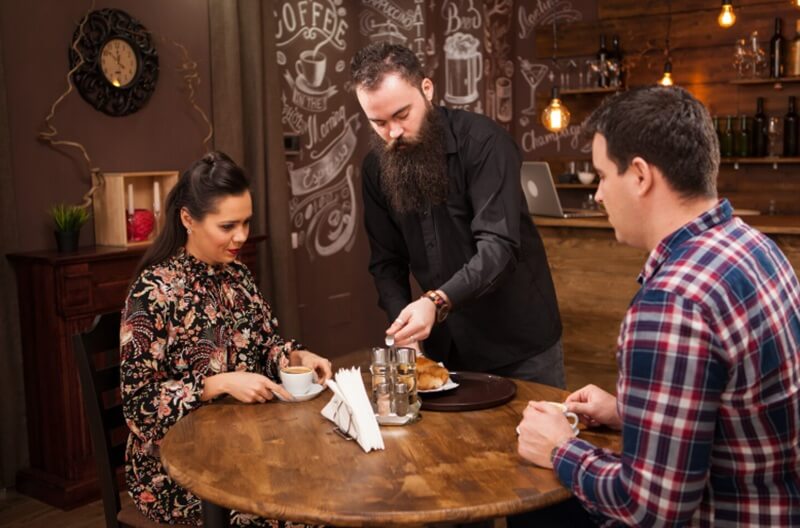
When no one is standing at the bar, a pub has a rather calm atmosphere. The hum feels confined, even tamed, but it’s not precisely silent glasses still clink and laughter still rises in erratic bursts. Tables turn into islands. The pace slows. Additionally, the bar, which was originally the room’s gravitational center, becomes a sort of backdrop. If you’ve spent years witnessing strangers engage in discussions they never intended to have, it’s difficult to ignore the change.
The British pub has operated more like a common living room with dim lighting and excellent stories than a restaurant for decades. It was more than just a transaction to place an order at the bar. It was a ritual that was full of possibilities, occasionally chaotic, and frequently irritating. Small gestures like a nod from someone waiting next to you or a raised eyebrow from the bartender had social weight. The widespread introduction of table service during the pandemic has started to reorganize that choreography in ways that feel both useful and, possibly, subtly disruptive.
| Category | Details |
|---|---|
| Topic | Table Service vs Bar Service in Pubs |
| Industry | Hospitality / Food & Beverage |
| Geographic Focus | United Kingdom |
| Cultural Context | British pub tradition, post-pandemic shifts |
| Key Stakeholders | Pub owners, staff, customers, accessibility advocates |
| Notable Organization | Campaign for Real Ale (CAMRA) |
| Core Debate | Social interaction vs efficiency & inclusivity |
| Emerging Trend | Hybrid service models, app-based ordering |
Of course, there is a compelling argument for it. On a Friday night, watching a packed pub could like watching a civilized kind of warfare. In an attempt to be seen, people lean forward and hold their cards a little higher than necessary. Some people never felt welcome in the setting, particularly those who had mobility problems or social anxiety. These edges have been softened by table service and ordering applications. It is more predictable. more under control. And, for many, just simpler.
There are trade offs associated with ease. There once was a pub in Oxford that was tucked away on a small street with a bar so crowded that people were talking on the sidewalk. Frequent visitors would arrive by themselves and go with new acquaintances, occasionally even friends. These contacts occurred because people were waiting for the same object, occupying the same physical place, and looking the same direction. They weren’t planned. That shared moment vanishes with table service. Everybody is already sitting, comfortable, and surrounded by their group.
There’s a feeling that power, not simply alcohol, is being subtly transferred. Both patrons and employees are treated fairly equally at the bar. You come over, you inquire, and you wait for your turn. The dynamic changes with table service. Employees move around. Clients don’t change. The exchange becomes increasingly fragmented and formal. Even though no one calls it that, it starts to look like a restaurant.
In contrast, pub proprietors appear to be torn between two instincts. Table service may, on the one hand, result in higher expenses. Consumers stay longer, place more orders, and occasionally are convinced by helpful employees who recommend a plate of food or another drink. It requires more work, coordination, and sometimes patience than a hectic Friday night can provide. Managing several tables and balancing conflicting needs while attempting to preserve the appearance of simple service has been regarded by several employees as stressful.
The long term viability of this approach is yet unknown, especially for smaller bars with narrow profit margins. Although a busy bar may appear ineffective or even chaotic, it enables a single bartender to swiftly service a large number of patrons. By redistributing that workload throughout the room, table service pushes employees in ways that patrons aren’t always able to see.
Then there is the cultural question, which is more difficult to measure but challenging to ignore. Social boundaries have traditionally been blurred at pubs. Those limits are often reinforced when one is seated at a table. You remain in your group. You converse with your companions. The likelihood of striking up a discussion with someone who is completely out of your social circle decreases significantly.
One frequent patron once referred to the pub as common land, where everyone is theoretically free to connect and no one actually owns the space. That notion seems more and more brittle. By its very nature, table service provides private spaces. You’re not supposed to relocate. Not supposed to socialize. That is reassuring in certain respects. For others, it’s subtly lonely.
Not everyone laments the shift. Ordering from a table eliminates a layer of discomfort that used to accompany packed bars, according to several patrons, especially women. No more dodging unwelcome attention or being ignored. The sensation gets more controlled and serene. For them, the change is more of a corrective than a loss.
Pubs seem to be at a crossroads as this develops, even though it’s not immediately apparent. There’s nothing dramatic going on. No broad statements, no abrupt disappearance of bars. Little changes that add up over time. Several more tables. There are a few fewer individuals on the ground. a rhythm that is a little different from the evening.
Maybe it’s not one or the other in the future. Some establishments will maintain both, experimenting with hybrid models that provide consumers a choice. Even still, there are concerns. Will individuals return to the bar if given the choice, or has our desire to use these areas already changed? It’s possible that expectations, rather than just services, are changing. The bar, which used to be characterized by its unpredictability and looseness, is starting to become a little more confined and structured. Not totally. Not quite yet. It’s difficult not to worry what else might subtly vanish next to the bar while you’re standing in a quiet room with no lines.