
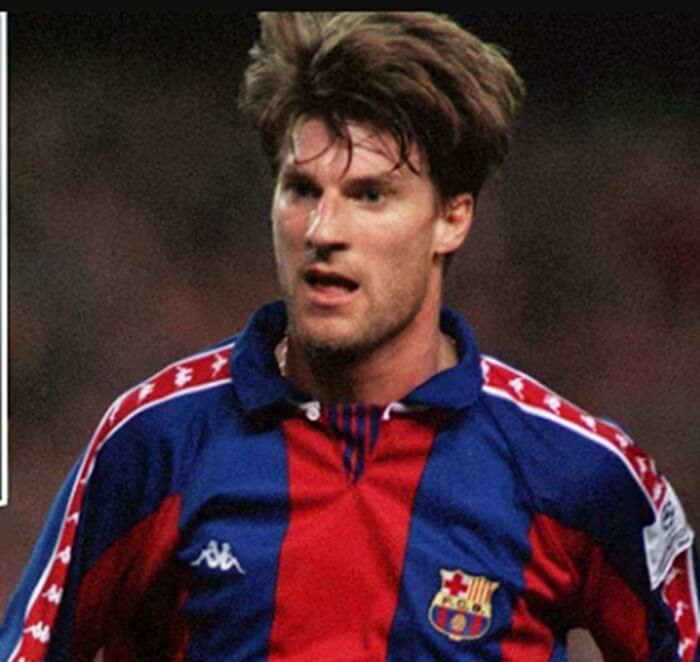
Michael Laudrup has amassed wealth in a way that seems appropriate quiet, elegant, and nearly fuss free. It reminded me of how he used to walk over the grass at Camp Nou, head high, and appear to be in no hurry as everyone else scurried around him. When it comes to Michael Laudrup’s wealth, the figures speak for themselves. The way he earned them speaks for itself.
Michael Laudrup’s estimated net worth as of 2026 is between $35 and $45 million. Context is important, even though it might not match the enormous numbers associated with contemporary celebrities. Laudrup lived in a time when Saudi backed contracts changed the salary structure and before broadcast deals took off. In the mid 1990s, he was a member of Europe’s elite, earning 12 to 14 million Danish kroner a year at Real Madrid. These pay appear even more amazing when adjusted for inflation.
| Full Name | Michael Laudrup |
|---|---|
| Date of Birth | 15 June 1964 |
| Place of Birth | Frederiksberg, Denmark |
| Nationality | Danish |
| Playing Position | Attacking Midfielder |
| Clubs Played For | Brøndby, Lazio, Juventus, Barcelona, Real Madrid, Vissel Kobe, Ajax |
| International Caps (Denmark) | 104 |
| International Goals | 37 |
| Major Honors (Player) | 5× La Liga Titles, 1× European Cup (1992), Serie A Title, Eredivisie Title |
| Management Career | Brøndby, Getafe, Spartak Moscow, Mallorca, Swansea City, Lekhwiya, Al Rayyan |
| Business Interests | Michael Laudrup Holding A/S, Laudrup Vin |
| Estimated Net Worth | $35 – 45 million (approximate) |
One gets the impression that Laudrup was unconcerned with branding or international marketing deals while seeing archive footage of him during that 1995 Real Madrid 5 0 thrashing of Barcelona. He had come to play. However, he was still able to establish long term financial security despite his little presence. It might have even been beneficial.
His career as a player set the groundwork. Along with a European Cup in 1992, he won five La Liga titles four with Barcelona and one with Real Madrid making him not just a Danish but a continental legend. Strong contracts in Spain and Italy, as well as subsequently in Japan with Vissel Kobe and Ajax, were the results of this status. Although football earnings were lower back then, elite players were still able to command high incomes.
He developed a stable investment portfolio through Michael Laudrup Holding A/S. With equity holdings of more than 20 million Danish kroner and significant stakes in other businesses, recent filings revealed profits of almost 4 million Danish kroner in a single fiscal year. You can practically sense the change as you stand outside Falsled Kro, a quaint inn with a thatched roof on Denmark’s southern coast that is somewhat related to his investments. It’s not ostentatious wealth. It is generational prosperity rooted in material possessions.
Laudrup Vin, his wine import company, is another. It feels exactly like the brand: sophisticated, subtle, and European. In the same way that he formerly analyzed defensive lines, one can picture him conducting a tasting event and quietly discussing Rioja or Bordeaux. Investors appear to value this cautious growth more than high risk, attention grabbing endeavors.
Another financial layer was added by his managerial career. All of these positions Swansea City, Spartak Moscow, clubs in Qatar extended his earning years, even if none of them came with Premier League megastar pay. Notably, he achieved domestic doubles in Qatar and won the League Cup with Swansea, which increased his marketability outside. Although his name occasionally comes up when prominent positions open up, it is still uncertain if he will return to European management.
Laudrup’s salary may seem low in comparison to contemporary Danish players like Rasmus Højlund, whose transfer costs reach the hundreds of millions of kroner. However, transfer assessments adjusted for inflation indicate that his 1994 trade to Real Madrid would now be close to 900 million kroner. In this way, Michael Laudrup’s wealth, which he acquired before to the full arrival of the financial boom, represents the importance of a pioneer.
The issue of legacy income is another. Over a 25 year span, Laudrup won the title of Best Foreign Player in Spanish football and received a knighthood in Denmark. These accolades support speaking engagements, ambassadorships, and advisory positions even though they don’t immediately translate into cash. There’s a sense that his brand still has quiet currency when you see how frequently former teammates, like Pep Guardiola, still talk about his genius.
It’s difficult to ignore how his path differs from that of some of his peers who experienced bankruptcy or made poor decisions. Laudrup seems to have shied away from luxury. No scandals in tabloids. No extravagant expenditures on the front pages. If anything, his financial background reflects his playing style, which is smart, effective, and a little ahead of schedule.
And that might be the most illuminating aspect of Michael Laudrup’s wealth. It’s not based on spectacle. It is based on consistent success, prudent investment, and the kind of long term thinking that midfielders good ones, at least need to develop.
Future commercial ventures rather than football contracts will probably determine whether his wealth increases much from this point on. He has undoubtedly obtained something more useful than raw stats, even if it stays steady. steadiness. standing. Regard. That seems perfectly fitting for a player who Johan Cruyff famously said was performing at a different level when playing like a dream.
i) https://www.thesefootballtimes.co/2017/01/03/michael-laudrup-the-brilliant-playmaker-who-sits-alongside-the-greatest/
ii) https://www.linemagazine.co.uk/uncategorized/how-much-money-michael-laudrup-earns-see-his-wealth-
iii) https://www.express.co.uk/sport/football/968051/Real-Madrid-next-manager-Zinedine-Zidane-Michael-Laudrup
iv) https://www.walesonline.co.uk/sport/football/football-news/michael-laudrup-managerial-success-surprised-6022921