
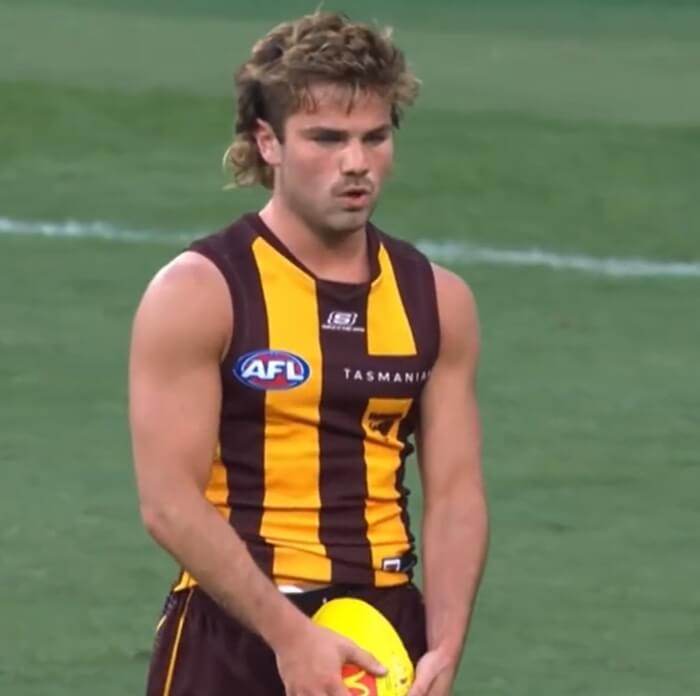
Every time Nick Watson dashes into the forward 50, a certain moment is repeated, almost like a ritual. At the MCG, Waverley Park, or any other location when Hawthorn is playing, fans move in their seats. In order to come closer to whatever he might do next, some actually move, jogging across quarters from one arc to the other. He weighs 68 kg and stands 170 centimeters tall, making him the least physically intimidating person on any surface.
That doesn’t seem to matter, though, for some reason. Since he was a young child growing up in Croydon South, one of Melbourne’s eastern suburbs, people have been curious about Nick Watson’s height. According to his mother, he asked why he wasn’t growing as tall as the other children. A person who could so easily be reduced to a highlight reel is humanized by this kind of detail. He was not expected to be enormous. Simply said, he was quicker, sharper, and more instinctual than practically everyone around him, and at some point, it proved to be more than sufficient.
| Field | Details |
|---|---|
| Full name | Nicholas Watson |
| Date of birth | 24 February 2005 (age 21) |
| Birthplace | Melbourne, Victoria, Australia |
| Height | 170 cm (5 ft 7 in) |
| Weight | 68 kg (150 lb) |
| Position | Forward / Midfielder |
| Club | Hawthorn Football Club |
| Guernsey number | #5 (previously #34) |
| Draft | Pick 5, 2023 AFL National Draft |
| AFL debut | Round 1, 2024 vs. Essendon (MCG) |
| Contract | Signed through end of 2029 |
Hawthorn chose Watson with the fifth choice in the 2023 AFL National Draft. He may have been the shortest player invited that year, according to reports at the combine. During the formal testing sessions, he was wearing a moon boot due to an ankle injury. However, pre-draft scouting had already verified what junior football watchers had been saying for the past two years: this kid could kick a football more effectively than he could walk as a toddler, and not much had changed since. At the Under-18 National Championships, he led Vic Metro with 14 goals in just four games, earning an All-Australian selection. Regardless of what the tape measure indicated, he was by most accounts a legitimate top-ten talent.
Perhaps he was sharpened by the physical examination. One of two things will happen to a football player who grows up as one of the smaller kids in every peer group: either their confidence will be eroded or something new will take its place. Watson appears to have learned that lesson well, having been coached during his under-15 years by North Melbourne legend Brent Harvey, who is by no means a titan of the game. Over 400 AFL games were played by Brent Harvey. His height was 173 centimeters. This feels like an important lineage.
There was very little cause for doubt after Watson’s first Hawthorn season in 2024. He averaged 10.8 disposals per game, kicked 25 goals, and participated in 18 games. More importantly, 20 of those goals were scored following the midseason bye, indicating developing poise rather than just skill. He collected 12 disposals and kicked three goals in a 66-point thrashing against Collingwood in a Round 19 match. This kind of performance earns him a nomination as a Rising Star and is replayed on club broadcasts for the following month. He was named Hawthorn’s season’s Most Promising Player. He was nineteen.
It seems that the relationship between small forwards and Australian football has always been complex. A player of Watson’s size may be marginalized by the way the game rewards contested marks and aerial presence. The sport continues to produce players who defy those presumptions, such as West Coast’s Cousins-era small forwards, Alan Didak of Collingwood, whose inventiveness Watson has mentioned as an inspiration, and more recently, Sydney’s Tom Papley and Melbourne’s Kysaiah Pickett, who both seem to view taller opponents as more of a hassle than a barrier. Watson belongs in that company. The nickname “The Wizard” didn’t come from a marketing department. It came from watching him in traffic, finding angles that don’t visibly exist, conjuring goals from situations that look closed off.
In 2025, his second AFL season, Watson played all 25 matches and kicked 36 goals. His contract was extended through to the end of 2029 a statement from the club that speaks plainly about how they see his future. By December of that year, he was assigned the number 5 guernsey, previously worn by traded midfielder James Worpel. Guernsey numerals have significance at Hawthorn, even though it’s a small element in the larger arc. The 34 he’d worn for 43 games was given up for something the club clearly considered more permanent.
At 170 centimetres, Nick Watson’s height will always be noted in profiles like this one. It’s listed, measured, and commented on because that’s what the AFL ecosystem does with players who don’t fit the traditional mold for their position. But watching him negotiate a packed front 50 low centre of gravity working in his favour, elusive abilities leaving bigger opponents in his wake it becomes harder to treat the number as anything more than a footnote. He’s quick, he’s intelligent, and by most accounts he still has years of development ahead of him.
It’s impossible not to notice that the players Watson idolises most aren’t typically the biggest either. They were, instead, the most intriguing to watch. That instinct to chase spectacle over size says something about the footballer he’s choosing to become.